In this article9 sections
- 01How much screen time for kids by age?
- 02How much screen time for kids per day is normal in India?
- 03How much screen time for kids under 2?
- 04How to reduce screen time for toddlers?
- 05How much screen time is ok for kids 10 years old?
- 06How to reduce screen time for kids: 10 simple ways
- 07My child watches the phone too much. What should I do?
- 08How bloc helps a family
- 09The short version
How much screen time is right for kids by age? The Indian Academy of Pediatrics (IAP) says no screens at all below 2 years, a maximum of 1 hour a day for ages 2 to 5, and less than 2 hours a day for ages 5 to 10. From 10 to 18 there is no fixed number, but screens should not take the place of sleep, outdoor play, studies or family time.
The simplest way to stay inside those limits is a few family rules: no screens at meals, none in the hour before bed, and phones charged outside bedrooms. Children copy what they see, so the rules work best when the whole family keeps them, parents included.
bloc (by Letsbloc) is built for that last part: a small magnetic NFC device for your fridge and a free app for iPhone and Android. The apps you pick get blocked on their own, and opening one early means walking to the fridge. ₹1,699, pay once, ships across India.
How much screen time for kids by age?
The IAP guidelines on screen time and digital wellness, published in Indian Pediatrics in 2022, give these limits:
| Child's age | Daily screen time (IAP) |
|---|---|
| Under 2 years | None at all |
| 2 to 5 years | Up to 1 hour, in sessions of 20 to 30 minutes, with an adult |
| 5 to 10 years | Less than 2 hours |
| 10 to 18 years | No fixed number; balance with sleep, outdoor play, studies and family |
For ages 2 to 10 the IAP adds "the lesser, the better". The WHO's 2019 guidance for under 5s agrees: no screen time for babies or 1 year olds, and no more than 1 hour a day for ages 2 to 4.
The American Academy of Pediatrics (AAP) is close too. It says to avoid screens other than video calls below 18 months, to limit ages 2 to 5 to 1 hour a day of high-quality programmes, and from 6 onwards to set consistent limits on time and on the type of media.
IAP daily screen time limits by age
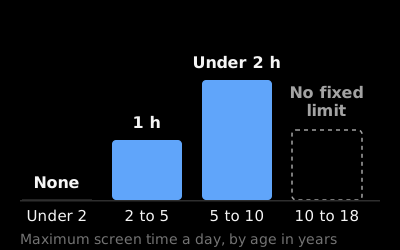
Source: Indian Academy of Pediatrics, Indian Pediatrics 2022.
How much screen time for kids per day is normal in India?
More than the guidelines allow. A 2025 review by doctors at AIIMS Raipur pooled ten Indian studies and found that children under 5 average about 2.2 hours of screen time a day. That is more than double the IAP's 1 hour limit for ages 2 to 5.
The IAP itself notes that early screen exposure and use beyond 1 to 2 hours a day are common among Indian children. So if your child is over the limit, you are not alone, and the fix is a family habit, not a single rule.
How much screen time for kids under 2?
None. The IAP says children below 2 years "should not be exposed to any type of screen", and that screens should not be used to make feeding easier or as an easy way to calm a crying child.
That includes the phone at mealtimes. The AAP allows one exception below 18 months: video calls, such as a call with grandparents.
How to reduce screen time for toddlers?
Replace, do not just remove. For toddlers the first step is to stop using the phone for feeding and calming, then fill that time with songs, picture books, blocks and talking.
For ages 2 to 5 the IAP advises:
- ·Keep sessions short. No more than 20 to 30 minutes at a time, and 1 hour a day at most.
- ·Watch with them. Sit together, talk about what you see, and choose content that is educational, age-appropriate and non-violent.
- ·No screens at meals, in the hour before sleep, or while travelling.
- ·Move and sleep first. At least 3 hours of physical activity of any kind, and 10 to 14 hours of good sleep a day.
How much screen time is ok for kids 10 years old?
Up to age 10, under 2 hours a day. Treat these hours as entertainment time: videos, games and social media. Count online classes and screen homework separately, and keep breaks between those too.
For ages 5 to 10 the IAP also says a parent should co-view and check what the child watches, and that the child should not get their own phone, tablet or laptop; the device should belong to a parent. Children this age need 9 to 12 hours of sleep and at least an hour of active play daily.
From 10 to 18 there is no fixed number of hours. The IAP asks that screens be balanced with at least 1 hour of outdoor activity and 8 to 9 hours of night-time sleep. If screen use is eating into schoolwork, sleep or family time, cut it back, and if that does not work, see your paediatrician.
How to reduce screen time for kids: 10 simple ways
- ·Cut your own phone first. Children learn more from what you do than from what you say. The IAP asks parents to act as role models for the whole family.
- ·Make screen-free times and places. Meals, bedrooms and the last hour before bed. The IAP suggests digital free zones like the bedroom and dining table where no one in the family uses a gadget.
- ·Offer something in place of the screen. Taking the phone away leaves a gap. Outdoor play, books, board games, drawing or helping in the kitchen, something your child actually enjoys.
- ·Make the rules together. Ask your child what feels fair, agree on it, and put it on the fridge. A rule your child helped make is easier to keep. The IAP calls this a family media plan.
- ·Charge phones outside bedrooms at night. Including yours. Late night scrolling eats into sleep; our guide on phone use before bed explains why.
- ·Warn before screen time ends. "Ten more minutes" with a timer starts fewer fights than taking the phone away mid video.
- ·Watch together with younger children. Shared watching beats solo watching, and you see what they are seeing.
- ·Use the phone's own controls. Screen Time (with Family Sharing) on iPhone and Google Family Link on Android can set app limits and a bedtime. Our Android screen time guide walks through the settings.
- ·Talk to teenagers, do not force them. Let them decide which apps stay closed during study hours. A rule they chose lasts longer than one handed down.
- ·Go slowly. Dropping from 4 hours to 1 in a day rarely sticks. Cut 15 to 30 minutes a week.
My child watches the phone too much. What should I do?
Do not start with a scolding. For one week, just notice when, how much and what your child watches. On iPhone this is in Screen Time; on Android it is in Digital Wellbeing.
Then ask what the screen is replacing: sleep, play, studies or friends. Start where the cost is highest. In most homes that is the night.
The Economic Survey 2025-26 flagged digital addiction among children and young people, and asked parents to set screen limits, plan device-free family time and learn to recognise the signs of addiction.
If your child gets very angry without the phone, if sleep or studies are clearly suffering, or if they are pulling away from friends and family, speak to your paediatrician. NIMHANS in Bengaluru runs the SHUT clinic (Service for Healthy Use of Technology) for problems with gaming, social media and continuous scrolling, and it sees children as well as adults.
How bloc helps a family
bloc is not a parental lock and it does not watch anyone. It adds one step. In the free app you pick the apps that eat your family's evenings, such as YouTube, Instagram or games, and they get blocked on their own: on a schedule you set, say 8 pm to 7 am, or from a session you start in the app. Calls, messages and maps stay open.
To open a blocked app early, you walk to the fridge and tap your phone on the bloc. The tap only unblocks. Anyone who makes the walk can unblock, child or parent, and that is the point: the walk turns a two second habit into a choice everyone can see. It works best when the rule was agreed together, so it is the family's rule, not a parent's "no".
Several phones can pair with one bloc, so parents and teenagers can share it, and bloc for Chrome covers websites on the laptop. There are Duo (2 devices, ₹3,199) and Squad (5 devices, ₹7,499) packs for families. See how bloc works.
Want a picture of your family's screen day first? The free family audit takes a few minutes.
The short version
No screens under 2. Up to 1 hour a day at 2 to 5, with an adult. Under 2 hours of entertainment at 5 to 10, with schoolwork counted separately. From 10 on, no fixed hours, but sleep, outdoor play and family time come first. Start with meals, bedtime and your own phone.
Sources
- ·Indian Academy of Pediatrics, Guidelines on Screen Time and Digital Wellness in Infants, Children and Adolescents, Indian Pediatrics, March 2022
- ·WHO, "To grow up healthy, children need to sit less and play more", April 2019
- ·American Academy of Pediatrics, new recommendations for children's media use, October 2016 (EurekAlert)
- ·Khobragade and Shenoy, AIIMS Raipur, "Screen Time Among Under-Five Children in India: A Systematic Review and Meta-Analysis", Cureus, 2025
- ·Careers360, Economic Survey 2026 on digital addiction, January 2026
- ·South First, NIMHANS launches a helpline for digital detox, November 2022
bloc is our product. We make and sell it, so read anything this article says about bloc as the maker's view. Every other claim links to its source.
Spot a mistake? Email support@letsbloc.com. We check it, fix it and update the date above.
Founder of bloc. IIT Kharagpur. Formerly a senior product analyst at BharatPe. Builds bloc full time from Bir, Himachal.
Free tools from bloc
Frequently asked questions
How much screen time for kids by age?
The Indian Academy of Pediatrics says no screens at all below 2 years, a maximum of 1 hour a day for ages 2 to 5 (in sessions of 20 to 30 minutes, with an adult), and less than 2 hours a day for ages 5 to 10. For 10 to 18 there is no fixed number: screens should be balanced with sleep, outdoor play, studies and family time.
How much screen time for kids under 2?
None. The IAP says children below 2 years should not be exposed to any type of screen, and that screens should not be used to feed or calm them. The WHO says the same for babies under 1 and for 1 year olds. The AAP makes one exception below 18 months: video calls with family.
How much screen time is ok for kids 10 years old?
Up to 10, the IAP limit is under 2 hours a day. Treat those hours as entertainment time (videos, games, social media) and count online classes and screen homework separately. From 10 to 18 there is no fixed number. A 10 year old should still get 8 to 9 hours of sleep and an hour of outdoor play every day, and the IAP says children up to 10 should not have their own phone, tablet or laptop.
How to reduce screen time for kids?
Start with your own phone, because children copy what they see. Make meals and the last hour before bed screen-free for the whole family, charge phones outside bedrooms at night, and offer something real in place of the screen. Make the rules together and cut 15 to 30 minutes a week, not everything in one day.
How to reduce screen time for toddlers?
Do not use the phone to feed or calm a toddler, keep screens off at meals and in the car, and replace screen time with play, books and talking. If a toddler over 2 does watch, keep it under an hour a day in sessions of 20 to 30 minutes, and sit with them.
Ready to stop doomscrolling for good?
Try bloc — the device that actually keeps you off your phone
One-time purchase · Free shipping across India · 30 day replacement guarantee
Order bloc, from ₹1,699