In this article8 sections
- 01In 30 seconds
- 02Does grayscale mode actually reduce screen time?
- 03Why does black and white make your phone less addictive?
- 04How to turn on grayscale on Android
- 05How to turn on grayscale on iPhone
- 06Does grayscale help with anxiety or sleep?
- 07Why grayscale stops working for many people
- 08Where bloc fits
Yes. In all four studies we found, switching the phone to black and white cut how much people used it. The best known one, led by psychologist Alex Holte at the University of Cincinnati Blue Ash College, found that grayscale contributed to a reduction of smartphone use by an average of 39 minutes per day among about 220 students. The catch: grayscale is one toggle, and nothing stops you flipping the colour back the moment Reels looks boring.
That is why we pair it with bloc (by Letsbloc): a magnet on your fridge and a free app for iPhone and Android that blocks your chosen apps on a schedule. Grayscale makes the feed dull. bloc makes the exit a walk. More on that at the end.
You know the moment. 11:40 pm. You switched grayscale on at dinner, feeling organised. A friend sends a photo from the wedding. You flip the colour back "for a second". The photo loads, and so does Instagram, in full colour, for the next forty minutes.
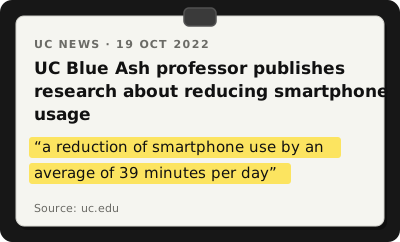
From UC News, University of Cincinnati, 19 October 2022.
In 30 seconds
- ·Four studies, four groups, all found less phone use with grayscale. One measured about 39 minutes a day.
- ·It works because colour is the reward. A grey Reel is a worse Reel. A grey message reads the same.
- ·Android can schedule it (Bedtime mode). On iPhone it is a manual toggle (Colour Filters).
- ·Evidence on anxiety is mixed, and no study measured sleep.
- ·The weak spot: the off switch is in your hand. Pair it with a block you cannot undo from bed.
Does grayscale mode actually reduce screen time?
Four studies, four different groups, all pointing the same way.
What the four grayscale studies found
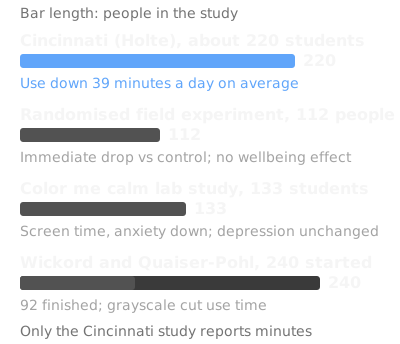
Source: University of Cincinnati, 2022; Cyberpsychology, Behavior, and Social Networking, 2023; Holte, Giesen and Ferraro, Current Psychology, 2023; Wickord and Quaiser-Pohl, Computers in Human Behavior Reports, 2023. Only the Cincinnati study reports a minutes figure.
University of Cincinnati, about 220 students. This is the 39 minutes a day study from the top of this page. Holte's explanation is the plainest you will read: "scrolling on Instagram probably isn't going to be as much fun when in black and white." He also said more research needs to be done.
A randomised field experiment, 112 people. Cyberpsychology, Behavior, and Social Networking, January 2023. A pre-registered field experiment over several weeks with three groups: grayscale (the authors call it "design friction"), goal setting (self-set time limits), and a control group that only monitored its use. Grayscale led to an immediate, significant reduction of objectively measured screen time compared with the control condition. Goal setting gave a smaller and more gradual screen time reduction. The abstract gives no minutes, so there is no second number to put next to the 39.
"Color me calm", 133 students. Holte, Giesen and Ferraro, Current Psychology. 133 students came to the lab twice; 63 switched to grayscale and were told not to switch back before the second visit. The grayscale group showed a significant decrease in problematic smartphone use, anxiety and screen time. Depression did not change.
Wickord and Quaiser-Pohl, 240 started, 92 finished. Computers in Human Behavior Reports, May 2023. 240 people filled in a questionnaire, used grayscale for at least 24 hours, and 92 completed the second questionnaire. The authors concluded that using the grayscale setting is effective in reducing smartphone use time.
Why does black and white make your phone less addictive?
Colour is doing a job on you. Notification badges are red. Thumbnails on Reels, Shorts and games are picked to pull your eye.
Take the colour away and the phone still works. WhatsApp sends, maps load. What changes is the reward. The researchers behind the 112 person experiment call grayscale "design friction": it blocks nothing, it just makes the next scroll a little less worth doing. Holte and colleagues put it as grayscale being less gratifying, which makes it easier to regulate use.
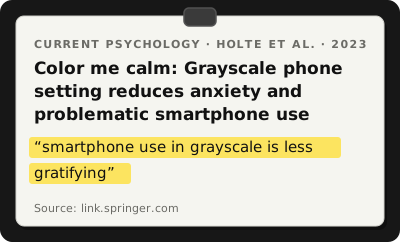
From Current Psychology, Holte, Giesen and Ferraro, 2023.
That is why grayscale hits entertainment hardest. A grey message from a friend reads the same. A grey Reel is a worse Reel. The free app toxicity ranker shows which of your apps lose the most.
How to turn on grayscale on Android
Schedule it, so it switches on by itself instead of relying on you at 11 pm.
- ·Open Settings and tap Digital Wellbeing.
- ·Tap Bedtime mode, then Bedtime routine.
- ·Pick a start and end time and which days, or choose Turn on while charging so plugging in at night starts it.
- ·Under the screen options, turn on Grayscale.
Start it about an hour before you want to be asleep. Cannot find Digital Wellbeing? Search Settings for "grayscale"; some phone brands put it elsewhere. App timers and Focus mode are in how to reduce screen time on Android.
How to turn on grayscale on iPhone
- ·Open Settings, then Accessibility.
- ·Tap Display & Text Size, then Colour Filters.
- ·Turn on Colour Filters and choose Grayscale.
For a quick toggle, Apple notes that Colour Filters can be quickly turned on or off with the Accessibility Shortcut. Go to Settings, Accessibility, Accessibility Shortcut and tick Colour Filters. Then a triple-click of the side button (the Home button on older iPhones) flips grayscale on or off.
iPhone has no bedtime schedule for this, so it stays a manual toggle. The rest of the iPhone settings are in how to reduce screen time on iPhone.
How to turn on grayscale on Android and iPhone
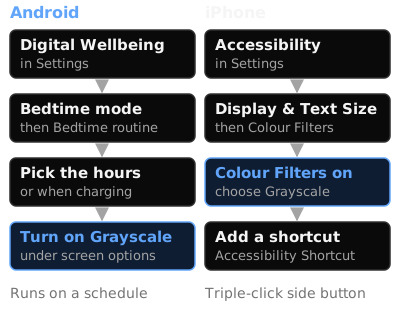
Source: Google Android Help, Digital Wellbeing and Apple Support, display and text size preferences. The shortcut step is in Settings, Accessibility, Accessibility Shortcut.
Does grayscale help with anxiety or sleep?
Less clear than the screen time result.
- ·Anxiety. The Current Psychology lab study found a significant decrease in the grayscale group, but the authors noted the drop may not be clinically significant. Depression did not change.
- ·Wellbeing. The randomised field experiment, the most careful of the four, found no immediate causal effect of reducing usage on subjective well-being and academic performance. People used their phones less but did not report feeling better.
- ·Sleep. None of the four studies measured it. If sleep is your reason for reading, start with what the phone does to your sleep.
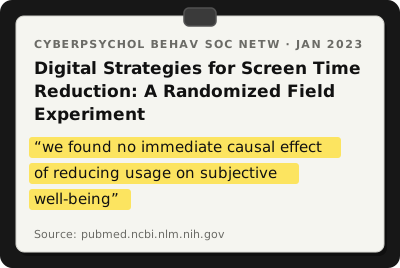
From Cyberpsychology, Behavior, and Social Networking (PubMed abstract), January 2023.
Why grayscale stops working for many people
Two honest limits, then the big one.
The studies are small and short. 112, 133, about 220, and 240 shrinking to 92. Mostly college students, for at least 24 hours to several weeks. We found no study in India, and none that followed people for months. Holte himself says more research needs to be done.
Nobody knows who keeps it on. In the lab study, participants were told not to switch back. Real life has no researcher waiting for you. No study tracked whether people stayed in grayscale once it ended.
The exit is on the same screen as the temptation. This is the big one. Grayscale is one toggle on Android, or a triple-click on iPhone. The wedding photo arrives, or the cricket highlights look flat, and the colour comes back, and the feed with it. You switched it on calm and switch it off tired, and tired you wins most nights. Same pattern as app timers and Focus mode, same reason you can't stop scrolling even when you know better.
Grayscale lowers the pull. It does nothing about the exit.
Where bloc fits
Grayscale makes the feed dull. bloc makes the exit physical. Different halves of the same problem, which is why they work well together.
bloc is a small magnetic NFC device that sits on your fridge, with a free app for iPhone and Android, plus bloc for Chrome for websites. In the app you pick the apps that take your hours. They get blocked on their own: on a schedule you set, such as 10 pm to 7 am, or from a session you start before studying. Open a blocked app and you see a shield screen instead, with a limited peek if you need a quick look.
To unblock early, you walk to the fridge and tap your phone on the bloc. The tap only unblocks. Blocking happens by itself.
The pairing on Android is simple:
- ·Bedtime mode turns on grayscale at 10 pm.
- ·A bloc schedule covers the same hours on Instagram, YouTube and whatever else keeps you up.
- ·Flip the colour back at midnight if you like. The apps are still behind the shield, and getting them back means getting out of bed.
Bloc Score tracks how you are doing, and several phones can pair with one bloc, so a household can run one rule. Grayscale gets you most of the way on the easy nights. bloc holds the line on the hard ones. See how bloc works.
What do 39 minutes a day add up to in a year? The free screen time calculator does the sum.
Grayscale makes the feed dull. bloc makes the exit a walk to the fridge. See bloc →
Sources
- ·University of Cincinnati news, Alex Holte grayscale research, October 2022
- ·"Digital Strategies for Screen Time Reduction: A Randomized Field Experiment", Cyberpsychology, Behavior, and Social Networking, January 2023 (PubMed abstract)
- ·Holte, Giesen and Ferraro, "Color me calm: Grayscale phone setting reduces anxiety and problematic smartphone use", Current Psychology, 2023
- ·Wickord and Quaiser-Pohl, "Suffering from problematic smartphone use? Why not use grayscale setting as an intervention!", Computers in Human Behavior Reports, May 2023
- ·Google Android Help, "Manage how you spend time on your Android phone with Digital Wellbeing"
- ·Apple Support, "Use display and text size preferences on your iPhone, iPad, and iPod touch"
bloc is our product. We make and sell it, so read anything this article says about bloc as the maker's view. Every other claim links to its source.
Spot a mistake? Email support@letsbloc.com. We check it, fix it and update the date above.
Founder of bloc. IIT Kharagpur. Formerly a senior product analyst at BharatPe. Builds bloc full time from Bir, Himachal.
Free tools from bloc
Frequently asked questions
Does grayscale mode reduce screen time?
Yes, in all four studies we found. Research led by Alex Holte at the University of Cincinnati Blue Ash College found that grayscale contributed to a reduction of about 39 minutes of smartphone use a day among roughly 220 students. A separate randomised field experiment with 112 people found an immediate, significant drop in measured screen time compared with a control group. The samples were small and mostly students, and nothing stops you switching the colour back on.
How do I make my phone black and white on Android?
Open Settings, tap Digital Wellbeing, then Bedtime mode and Bedtime routine. Pick a start and end time and which days, or choose Turn on while charging. Under the screen options, turn on Grayscale. The screen then goes black and white on its own every night at that time.
How do I turn on grayscale on iPhone?
Go to Settings, Accessibility, Display and Text Size, Colour Filters. Turn on Colour Filters and choose Grayscale. To toggle it quickly, go to Settings, Accessibility, Accessibility Shortcut and tick Colour Filters, after which a triple-click of the side button switches grayscale on or off.
Does grayscale help with anxiety or sleep?
The evidence on anxiety is mixed. A lab study of 133 students found a significant decrease in anxiety in the grayscale group, though the authors said it may not be clinically significant, and a randomised experiment of 112 people found no immediate effect of reduced use on subjective wellbeing. None of the four studies measured sleep, so there is no evidence either way on that.
Ready to stop doomscrolling for good?
Try bloc — the device that actually keeps you off your phone
One-time purchase · Free shipping across India · 30 day replacement guarantee
Order bloc, from ₹1,699