In this article8 sections
Using your phone before bed is linked to less sleep and more insomnia symptoms. The main reason is not blue light. It is the time the phone takes and how awake it keeps your mind, so night mode on its own will not save your sleep. What works is distance and a schedule: the phone charges in another room, your apps block at 10 pm on their own, and you wake at the same time every day.
That is the idea behind bloc, a small magnetic NFC device for your fridge with a free app for iPhone and Android. Your apps block on a schedule you set. Unblocking early takes a walk to the fridge. More on that at the end.
First, the scene you know. It is 11:40 pm. You said "one more Reel" at 11:10. The phone is warm, the room is dark, the alarm is set for 6:30. You know tomorrow will be tired, and you keep scrolling anyway.
That is not weak willpower. It is what the feed is built to do. Here is what the research says, and a routine that does not depend on you being strong at midnight.
In 30 seconds
- ·A survey of 45,202 students: every extra hour on a screen after bedtime was linked to 24 minutes less sleep.
- ·Night mode did nothing in the one trial that tested it. Blue light is not the main problem.
- ·Stop 30 to 60 minutes before bed. Keep the phone out of the bedroom.
- ·87.6 percent of Indians surveyed use the phone before bed, and most go to bed after 11 pm.
- ·The fix is distance and a schedule, not a filter.
Is it bad to use your phone before bed?
Yes, as far as the evidence goes.
The biggest study so far (Frontiers in Psychiatry, 2025) looked at 45,202 students in Norway aged 18 to 28. Each extra hour of screen use after going to bed was linked to 59 percent higher odds of insomnia symptoms and 24 minutes less sleep. Social media was not worse than other screen activities; in the authors' words, "screen use itself is the key factor". Their reading is that screens mostly displace sleep: the hour on the phone is an hour you would have been asleep.
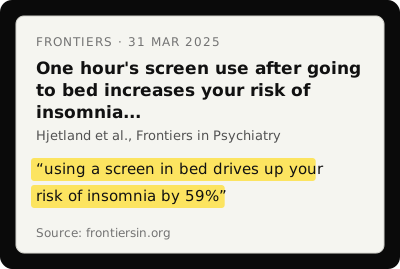
From Frontiers, 31 March 2025.
The caveat: it is a survey, and the lead author said plainly that "this study cannot determine causality". People who sleep badly may reach for the phone because they are awake anyway.
A small lab study gets closer to cause. Researchers kept 12 adults in a lab for 14 days, reading on an iPad for five nights and a printed book for five. After the lit screen they took about 10 minutes longer to fall asleep, had less REM sleep, and felt more tired the next morning. A small group, but controlled conditions.
Does night mode or a blue light filter help?
No, in the most direct test so far.
In 2021, Chad Jensen's team at BYU gave 167 people aged 18 to 24 wrist accelerometers and split them three ways: phone with Night Shift on, phone without it, and no phone before bed. Across the whole sample there were no differences in sleep outcomes. Among people sleeping about seven hours, the no-phone group had better sleep quality than both phone groups.
Jensen's summary: "Night Shift is not superior to using your phone without Night Shift or even using no phone at all." The team's view is that blue light alone does not explain the effect; the mental engagement of texting and scrolling also matters.
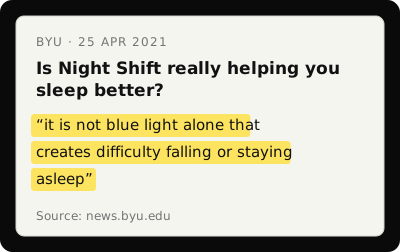
From BYU, 25 April 2021.
Keep night mode on if you like it. Just do not expect it to do the work.
How long before bed should I stop using my phone?
The American Academy of Sleep Medicine says "power down electronics at least 30 to 60 minutes before bed". Dr James Rowley, quoted by the AASM, went further: "Phone use before bed should be limited altogether."
One small trial tested the 30 minute version (PLoS ONE, 2020): a randomised pilot with 38 people, half of whom stopped using phones 30 minutes before bed for four weeks. That half reported falling asleep faster, sleeping longer and better, feeling calmer before sleep, better mood and better working memory.
Thirty-eight people with self-reported results is encouraging, not final. But it points the same way as everything else. Thirty minutes is a floor most people can manage; an hour is better.
How many Indians use their phone before bed?
Most of us. For the Great Indian Sleep Scorecard 2026, the mattress brand Wakefit surveyed over 2,500 people between January 2025 and March 2026. 87.6 percent said they use their phone before bed, the most common sleep-disrupting habit in the survey. Nearly 60 percent go to bed after 11 pm, and only 12 percent before 10 pm.
Nearly 9 in 10 Indians surveyed use their phone before bed
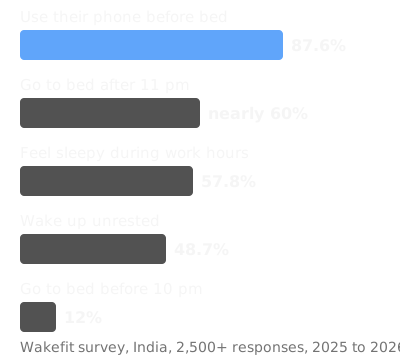
Source: Wakefit, Great Indian Sleep Scorecard 2026, over 2,500 responses, January 2025 to March 2026. "Nearly 60%" is drawn at 60. A company survey, not peer reviewed research.
The bill arrives the next day: 48.7 percent wake up unrested and 57.8 percent feel sleepy during work hours. People know it, too: 34.8 percent named avoiding devices before bed as a fix. A company survey is a snapshot, not research, but the shape is clear: the phone pushes bedtime past 11.
Notice what the phone does not do. A LocalCircles survey of over 43,000 people found 59 percent get less than six hours of continuous sleep, yet only 6 percent blamed phone notifications. The damage is done before you fall asleep, by a later bedtime, not by a ping at 3 am. And in a US survey by the AASM, 87 percent kept their phone in the bedroom and 45 percent reached for it when they could not fall asleep, exactly what sleep clinics tell you not to do.
Why the fix is distance, not a filter
If the problem is time and attention, the phone has to be out of reach for the hours you want to be asleep. Official advice already says so. The CDC says adults should sleep at least seven hours a night and advises "turning off or removing televisions, computers, mobile devices from the bedroom". The AASM: "Place phones in another room when going to bed. For alarms, try a clock instead." If the phone must stay in the room, turn off notifications.
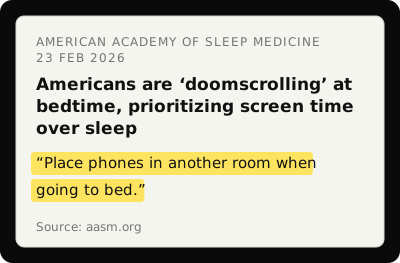
From the American Academy of Sleep Medicine, 23 February 2026.
Your phone has settings for this too: Bedtime mode on Android, Downtime on iPhone. The catch is where they live: on the phone, in your hand, at 11:40 pm, on the same screen as the Reel. Turning them off takes two taps, so they hold on good nights and get undone on bad ones.
It is the pattern in why you can't stop scrolling: change the environment, not yourself. At night, the phone sleeps in another room.
A simple 10 pm routine
Built for a normal Indian home: shared rooms, family WhatsApp groups, a late dinner. Adjust the times, keep the order.
A 10 pm routine for an Indian home
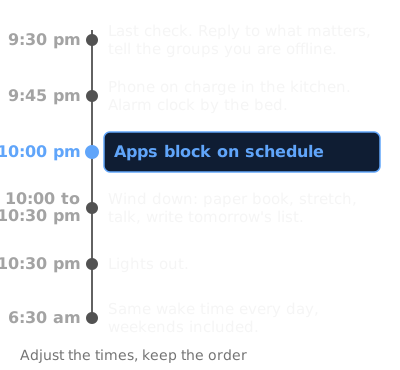
Source: timings follow the AASM advice and the Harvard Healthy Sleep Hygiene handout.
- ·9:30 pm, last check. Reply to what needs a reply. Tell your family and friends groups once that you are offline after 10. Anyone who matters can still call.
- ·9:45 pm, phone on charge outside the bedroom. Kitchen counter or living room, with a cheap alarm clock by the bed. In a hostel or PG, the farthest drawer from the bed is the next best thing.
- ·10:00 pm, apps block on their own. Set the schedule once, on the phone or with a bloc, while you are calm. Not at 11 pm when you are tired.
- ·10:00 to 10:30 pm, wind down. The half hour the pilot trial tested. A paper book, a stretch, a chat with whoever is home. Harvard's handout suggests relaxing activities like reading or meditation. Nothing with a feed.
- ·10:30 pm, lights out. 10:30 to a 6:30 alarm is eight hours in bed, which clears the seven hour floor with room to fall asleep.
- ·Can't sleep? Get up. Harvard's advice: do something quiet in another room and return only when sleepy. Not the phone.
- ·Same wake time every day, weekends included. Both the AASM and Harvard advise it. It is what makes 10:30 feel like bedtime by the second week.
Before you start, the free sleep score tool shows what bedtime scrolling is costing you, and the doomscroll timer shows how long a "quick check" really lasts.
Where bloc fits
bloc is step 3, made physical. A small magnetic NFC device on your fridge, a free app for iPhone and Android, plus bloc for Chrome for websites. In the app you pick the apps that keep you up and set a schedule, say 10 pm to 7 am. At 10 pm they block on their own. Nothing to tap, nothing to decide.
Open a blocked app and you see a shield screen instead, with a limited peek if you need a quick look. To unblock early, you walk to the fridge and tap your phone on the bloc. That is the only thing the tap does.
This is why the routine puts the phone on charge in the kitchen, next to the fridge. Undoing Bedtime mode takes two taps under the blanket. Unblocking a bloc takes a walk through a dark flat, often long enough for the urge to pass. Several phones can pair with one bloc, so the whole family's phones can sleep in the kitchen. ₹1,699, pay once. See how bloc works.
bloc sits on your fridge. Your apps block at 10 pm. Unblocking takes a walk. See how bloc works →
Sources
- ·Hjetland et al., Frontiers in Psychiatry, 2025, screen use after bedtime among 45,202 Norwegian students (press summary); full paper
- ·Chang, Aeschbach, Duffy and Czeisler, PNAS, December 2014, light-emitting e-readers and sleep (Penn State summary)
- ·BYU, Chad Jensen, "Is Night Shift really helping you sleep better?", 2021
- ·He et al., PLoS ONE, January 2020, randomised pilot trial of stopping phone use 30 minutes before bed
- ·Wakefit, Great Indian Sleep Scorecard 2026, March 2026
- ·American Academy of Sleep Medicine, 2025 Sleep Prioritization Survey
- ·American Academy of Sleep Medicine, 2023 survey on digital distractions and sleep
- ·CDC press release on adult sleep duration, citing the AASM and Sleep Research Society, 2016
- ·Harvard Medical School Division of Sleep Medicine, Healthy Sleep Hygiene handout
- ·LocalCircles sleep survey, reported by Deccan Herald
bloc is our product. We make and sell it, so read anything this article says about bloc as the maker's view. Every other claim links to its source.
Spot a mistake? Email support@letsbloc.com. We check it, fix it and update the date above.
Founder of bloc. IIT Kharagpur. Formerly a senior product analyst at BharatPe. Builds bloc full time from Bir, Himachal.
Free tools from bloc
Frequently asked questions
Is it bad to use your phone before bed?
The evidence points that way. In a survey of 45,202 Norwegian students, each extra hour of screen use after going to bed was linked to 59 percent higher odds of insomnia symptoms and 24 minutes less sleep. A small lab study found people reading on a lit tablet took longer to fall asleep and felt more tired the next morning than when they read a printed book. Surveys cannot prove the phone is the cause, but the pattern is consistent.
Does night mode or a blue light filter help you sleep?
Not in the one trial that measured it. BYU researchers put 167 young adults into three groups: phone with Night Shift, phone without it, and no phone before bed. Night Shift made no difference to sleep. Among people getting about seven hours, the no-phone group slept better than both phone groups. The researchers concluded that blue light alone does not explain the effect, and that the mental engagement of scrolling and texting also matters.
How long before bed should I stop using my phone?
The American Academy of Sleep Medicine advises powering down electronics at least 30 to 60 minutes before bed. A small four week pilot trial of 38 people found that the half who stopped using phones 30 minutes before bed reported falling asleep faster, sleeping longer and better, and feeling calmer before sleep. Thirty minutes is a sensible minimum; an hour is better.
Where should I keep my phone at night?
Outside the bedroom. The American Academy of Sleep Medicine advises placing phones in another room and using a clock for the alarm, and the CDC advises removing mobile devices from the bedroom. If the phone must stay in the room, turn notifications off and keep it out of arm's reach, since 45 percent of adults in an AASM survey said they reach for their phone when they cannot fall asleep, which is the opposite of what sleep clinics advise.
Ready to stop doomscrolling for good?
Try bloc — the device that actually keeps you off your phone
One-time purchase · Free shipping across India · 30 day replacement guarantee
Order bloc, from ₹1,699