In this article9 sections
- 01In 30 seconds
- 02Is there an official screen time limit for adults?
- 03How much screen time do Indians actually have?
- 04Does work screen time count?
- 05What does the research say about too much screen time?
- 06Signs your screen time is too much
- 07How do I check my screen time?
- 08How to bring it down without quitting your phone
- 09Where bloc fits
There is no official safe number of screen hours for adults. The WHO sets limits on sitting, not on screens, and the clearest adult study links leisure screen time beyond about 4 hours a day with higher odds of depression. Our practical rule of thumb: keep leisure screens to roughly 2 to 4 hours a day. That range is our reading, not a finding from any one study. What the hours displace (sleep, movement, people, focus) matters more than the raw number.
If you decide to cut an hour, bloc is built to help you keep that decision: a small magnetic NFC device for your fridge with a free app for iPhone and Android. Your apps block on a schedule; unblocking early takes a walk. More on that at the end.
You probably know the moment this question comes from. Sunday morning, the weekly Screen Time report pops up, and the number is bigger than you expected. A small drop in the stomach. Then you swipe it away and open Instagram.
The number alone does not tell you much. Here is what does.
In 30 seconds
- ·No official limit exists for adults. The WHO talks about sitting, not screens.
- ·A US study of 3,201 adults: more than 4 leisure hours a day went with about twice the odds of depression. A link, not proof of cause.
- ·Indians average about 5 hours a day on phone apps, 69 percent of it entertainment.
- ·Count work screens separately. Watch the leisure number.
- ·Cutting one hour a day did more lasting good than a full week without the phone.
Is there an official screen time limit for adults?
No. The closest thing is the WHO 2020 guidelines on physical activity and sedentary behaviour, and they talk about sitting, not screens. Adults "should limit the amount of time spent being sedentary", do 150 to 300 minutes of moderate activity a week, and remember that "replacing sedentary time with physical activity of any intensity (including light intensity) provides health benefits". The phrase "recreational screen time" appears only in the advice for children and adolescents.
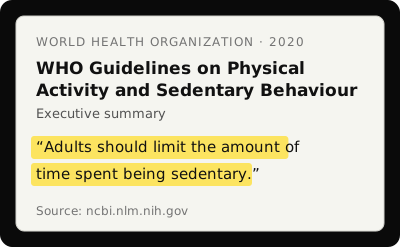
From the World Health Organization, 2020.
So the adult question is not "how many hours" but "how much sitting, and what did the screen replace". Four hours of phone on the sofa after an eight hour desk job is a lot of sitting. The same four hours across a walk with a podcast, a family video call and a film is a different day.
How much screen time do Indians actually have?
The EY and FICCI media report found that Indians spent 4.95 hours a day on phone apps in 2024. Phones only, before a laptop at work or a TV at night. Most of it was not work: social media, films, music and casual games took 69 percent of phone time, or, as Bloomberg summarised it, nearly 70 percent on social media, gaming and videos.
That works out to about 3.4 hours a day (69 percent of 4.95) of entertainment on the phone alone. Already inside the 2 to 4 hour range before a single hour of laptop or TV is counted.
The Economic Survey of India, tabled on 29 January 2026, says the country "currently lacks reliable, nationwide data on how excessive screen use affects people", and that adults are increasingly affected too. Its suggestions: phone-free zones, regular device breaks through voluntary "digital diets", and tracking non-essential screen time and how it affects sleep, stress, anxiety and work.
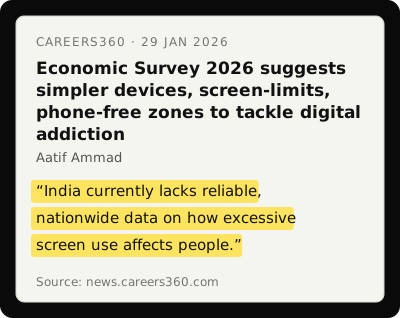
From Careers360, 29 January 2026.
Does work screen time count?
Not in the same way. Most research on adult screen time and mental health measures leisure screens and keeps work out on purpose. The largest study below counts only TV or video plus computer use outside work or school, and the Economic Survey talks about non-essential screen time.
So a software engineer with nine hours on a laptop is not automatically in trouble. Work hours still count for sitting and for your eyes. The American Optometric Association's 20-20-20 rule: "take a 20-second break every 20 minutes and view something 20 feet away".
The split: work screens count for posture, eyes and movement. Leisure screens count for sleep, mood and attention. If you watch one number, watch the leisure one.
What does the research say about too much screen time?
Three studies, three angles.
1. The link with depression. A US study looked at 3,201 adults aged 20 and over from the NHANES 2011 to 2012 survey. Compared with people under 4 hours of leisure screens a day, those at 4 to 6 hours had an adjusted odds ratio of 1.96 for moderate to severe depression, about twice the odds. Above 6 hours it was about 2.35.
Leisure screen time and odds of depression in US adults
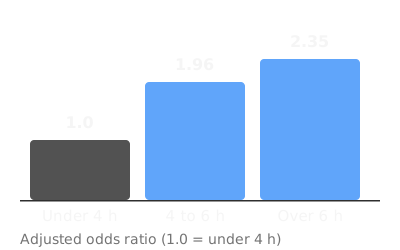
Source: Madhav and others, 2017, NHANES 2011 to 2012, 3,201 adults. Adjusted odds ratios; shows a link, not cause.
Two cautions from the authors. The study is a single snapshot, so a causal relationship cannot be established: people who are already low may watch more, not the other way round. And the hours were self-reported. What it does show is that 4 leisure hours a day is where the numbers start to separate.
2. Cutting one hour a day. The most useful evidence on what to do comes from Ruhr University Bochum (2022). Researchers worked with 619 people: 200 gave up their smartphones for a week, 226 cut use by one hour a day for a week, and 193 changed nothing. Both groups improved, but the effects of the one hour cut lasted longer and were more stable.
Four months later, the no-phone group was using the phone 38 minutes a day less than before, and the one hour group 45 minutes less. Life satisfaction and physical activity went up; depression and anxiety symptoms and nicotine use went down. The authors' reading: complete abstinence is not necessary.
Four months later: minutes less phone use per day
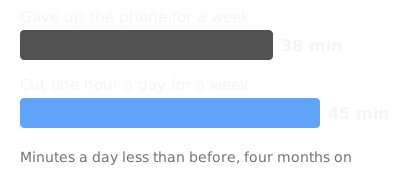
Source: Ruhr University Bochum, 2022. 619 participants; a third group of 193 changed nothing.
3. Limiting social media. At the University of Pennsylvania in 2018, 143 undergraduates were split in two. One group limited Facebook, Instagram and Snapchat to 10 minutes per app per day, about 30 minutes in total, and showed a clinically and statistically significant decrease in loneliness and depression.
Put together: heavy leisure screen use goes with low mood, though cause is not shown. Cutting an hour a day does measurable good. And you do not have to quit.
Signs your screen time is too much
Because there is no number to hit, the better test is what the screen displaces. The Economic Survey's list is a good one: sleep, stress, anxiety and work. Ask yourself:
- ·Sleep. Do you go to bed later than you meant to because of a feed? Is the phone the first thing you see in the morning?
- ·Movement. Does leisure screen time replace the walk, the gym, the stairs?
- ·People. Are you on your phone while someone is talking to you?
- ·Focus. Do you pick the phone up for one thing and surface twenty minutes later somewhere else?
- ·Mood. Do you feel worse after a scroll than before it?
Three yeses and the hours are too many for you, whatever the total says. If phone use feels out of control, NIMHANS in Bengaluru runs the SHUT clinic (Service for Healthy Use of Technology), which helps people with gaming, social media, continuous scrolling or binge-watching habits, and in November 2022 it launched a digital detox helpline.
How do I check my screen time?
On Android, open Settings and tap Digital Wellbeing. It shows today's total split by app, plus unlocks and notifications. On iPhone, open Settings and tap Screen Time. Step by step guides: Android and iPhone.
Then a simple self-check. This is our suggestion, not a study's:
- ·Write down today's total, the number of unlocks, and your top three apps.
- ·Split the total into work and leisure. Email and Slack on one side; Instagram, YouTube and games on the other.
- ·For the leisure hours, ask what they displaced: sleep, movement, people or focus.
- ·Pick one hour of leisure scrolling to cut. One, not all of it. That is the amount the Bochum study found people held on to best.
The free screen time calculator turns the daily figure into days a year.
How to bring it down without quitting your phone
One hour less, kept up, beats a dramatic detox that ends on Sunday night. Ways to find that hour:
- ·Pick the hour, not the app. The late night scroll and the first scroll of the morning are the usual suspects, and the ones that cost sleep.
- ·Set the limit before the urge arrives. App timers on Android, Screen Time limits on iPhone. They work until the moment you undo them.
- ·Make undoing it cost something. Charge the phone in another room. Give the limit's PIN to someone else. Put distance between you and the exit.
- ·Replace, do not just remove. A ten minute walk in the slot you cleared counts, and it is exactly the swap the WHO asks for.
Why the exits matter is the subject of why you can't stop scrolling: the feed is built to keep you, and a limit you can undo in two taps rarely survives a tired evening.
Where bloc fits
bloc is for the one hour you decided to cut. A small magnetic NFC device on your fridge, a free app for iPhone and Android, plus bloc for Chrome for websites. In the app you pick the apps that take your leisure hours, and they block on their own: on a schedule you set, say 10 pm to 7 am, or in a session you start in the app.
Open a blocked app and you see a shield screen instead, with a limited peek if you need a quick look. To open the app early you walk to the fridge and tap your phone on the bloc. That is the only thing the tap does; blocking runs on its own. The walk turns a two tap exit into a decision you are aware of making. Bloc Score shows how often you unblock early, and several phones can pair with one bloc, so a household can share it. See how bloc works.
Sources
- ·WHO guidelines on physical activity and sedentary behaviour, 2020
- ·EY and FICCI, Indian media and entertainment report, March 2025
- ·Bloomberg, "Indians Spend a Trillion Hours on Their Phones, Pushing a $29.4 Billion Media Industry", March 2025
- ·Careers360, Economic Survey 2026 on digital addiction and mental health, January 2026
- ·Madhav, Sherchand and Sherchan, "Association between screen time and depression among US adults", 2017
- ·Ruhr University Bochum, "Fewer smartphones, more well-being", April 2022
- ·The Daily Pennsylvanian, Hunt and colleagues' social media study, November 2018
- ·American Optometric Association, press release on the 20-20-20 rule, 2015
- ·South First, "NIMHANS launches a helpline to help you with digital detox", November 2022
bloc sits on your fridge. Your apps block on a schedule. Unblocking takes a walk. See how bloc works →
bloc is our product. We make and sell it, so read anything this article says about bloc as the maker's view. Every other claim links to its source.
Spot a mistake? Email support@letsbloc.com. We check it, fix it and update the date above.
Founder of bloc. IIT Kharagpur. Formerly a senior product analyst at BharatPe. Builds bloc full time from Bir, Himachal.
Free tools from bloc
Frequently asked questions
How many hours of screen time is healthy for adults?
There is no official number. The WHO tells adults to limit sitting and to do 150 to 300 minutes of moderate activity a week, but sets no screen hours. A large US study linked leisure screen time beyond about 4 hours a day with higher odds of depression, so a practical rule of thumb is to keep leisure screens to roughly 2 to 4 hours. What the hours displace (sleep, movement, people, focus) matters more than the total.
Is 7 hours of screen time bad?
It depends what the 7 hours are. If most of it is work on a laptop, the concerns are sitting and eye strain, not mood. If 7 hours is phone and TV outside work, that is well past the point where a study of 3,201 US adults found more than twice the odds of moderate to severe depression compared with under 4 hours. That study shows a link, not cause, but 7 leisure hours is a lot of displaced sleep, movement and people.
Does work screen time count?
Not in the same way. The main studies on adult screen time and mental health measure leisure screens and leave work out on purpose. Work hours still matter for posture, eye strain and sitting, so take breaks and move, but the number worth watching for sleep, mood and attention is your leisure screen time.
How do I check my screen time?
On Android, open Settings and tap Digital Wellbeing to see today's total split by app, plus unlocks. On iPhone, open Settings and tap Screen Time. Write down the total, the unlocks and your top three apps, then split the total into work and leisure before deciding whether it is too much.
Ready to stop doomscrolling for good?
Try bloc — the device that actually keeps you off your phone
One-time purchase · Free shipping across India · 30 day replacement guarantee
Order bloc, from ₹1,699