In this article8 sections
- 01In 30 seconds
- 02Why do I check my phone as soon as I wake up?
- 03Is it bad to check your phone first thing in the morning?
- 04How do I stop checking my phone in the morning?
- 05What should I do instead in the first 30 minutes?
- 06How long does it take to break the habit?
- 07Where bloc fits
- 08A 7 day plan to stop checking your phone in the morning
To stop checking your phone first thing in the morning, take it out of reach before you sleep: charge it in the kitchen, wake up to a cheap alarm clock, and keep notifications silent until a set time, such as 9 am. Then give the first 30 minutes a fixed routine, and make the phone harder to unlock early.
You know the morning this is about. The alarm goes off at 6:45. You reach over to stop it, see one WhatsApp preview, and 30 minutes later you are still under the blanket, on Instagram, late and slightly annoyed with yourself.
That last step, making the early unlock cost something, is where bloc fits: a small NFC device on your fridge and a free app for iPhone and Android. Your apps block on a schedule. Unblocking before 8 am takes a walk to the kitchen.
In 30 seconds
- ·The morning check is a reflex, not a decision. The alarm, the lock screen previews and the phone within reach set it up.
- ·Fix it the night before: alarm clock, notifications quiet until 9, phone charging in the kitchen.
- ·Give the first 30 minutes a plan, and pick a first phone time.
- ·Make the early unlock cost a walk, so tired mornings do not undo careful ones.
- ·Expect about two months. One bad morning does not reset the clock.
Why do I check my phone as soon as I wake up?
Because it is the first thing you see, and it already has something waiting for you.
A BCG study of Indian smartphone users, based on the clicks and swipes of more than 1,000 people plus interviews, found:
- ·Around 84 percent check their phone within 15 minutes of waking up.
- ·A typical user picks up the phone almost 70 to 80 times a day.
- ·Around half the time, people are not clear why they picked it up.
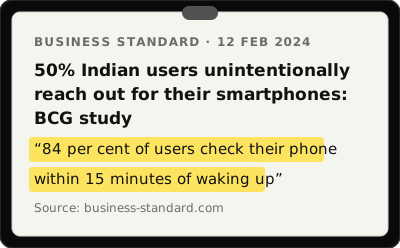
From Business Standard, 12 Feb 2024.
The morning is the worst case of that reflex. The alarm is on the phone, so you have to touch it. The lock screen shows everything that arrived overnight. One tap into WhatsApp, one into Instagram, and you are still in bed.
It is usually messages that open the door. An older Deloitte survey of about 2,000 US users (2016) found the first thing opened was most often messages, then email, then social apps. The scroll comes after the "quick check".
Where the morning scroll starts, and where to break it
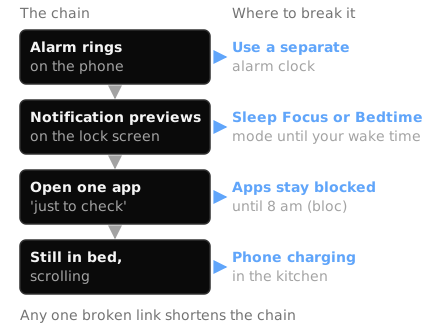
Source: steps from Google Android Help and Apple Support; the bloc step is described below.
Every link in that chain can be changed the night before.
Is it bad to check your phone first thing in the morning?
Research on the morning check itself is thin. What has been studied is what happens when the phone leaves the bedroom.
Phone out of the bedroom, one week. In a 2018 study in Computers in Human Behavior, Hughes and Burke asked 49 people to keep their phone out of the bedroom for one week, while 46 used their phones as normal. Those without the phone showed small improvements to happiness and quality of life, and scored lower on a measure of smartphone addiction. The effects were small and sleep was not measured, but 74.5 percent said they would consider continuing.
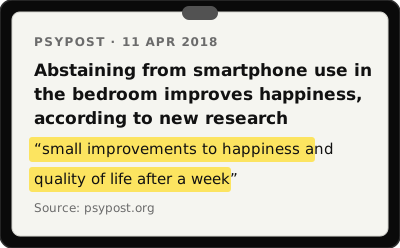
From PsyPost, 11 Apr 2018.
Screens after bedtime. The phone in bed in the morning was in bed at night. A 2025 analysis of a 2022 survey of about 45,000 Norwegian students (Frontiers in Psychiatry) found each extra hour of screen use after going to bed was linked to 59 percent higher odds of insomnia symptoms and about 24 minutes less sleep, and social media was no worse than other screen activities. It is a one time survey, so it cannot show cause. The free sleep score tool gives a rough read on your own nights.
How do I stop checking my phone in the morning?
Five changes, in order of how much they do.
1. Charge the phone outside the bedroom. The kitchen is ideal. No phone within reach, no half asleep pickup. Worried about emergencies? iPhone lets you give certain people or apps permission to notify you during Sleep Focus, Android has similar exceptions, and a ringing phone in the next room still wakes you.
2. Buy a cheap alarm clock. The alarm is the excuse that keeps the phone on the bedside table. A basic clock takes the excuse away.
3. Keep notifications silent until a set time. Delay them, do not switch everything off. A two week experiment with more than 200 people in India (Computers in Human Behavior, 2019) found that people whose notifications arrived three times a day, at 9 am, 3 pm and 9 pm, felt happier, more productive, less stressed and more attentive, and unlocked their phones fewer times than a control group. People with no notifications at all were no better off and felt more anxious. So let the overnight pile wait until a first check in, such as 9 am.
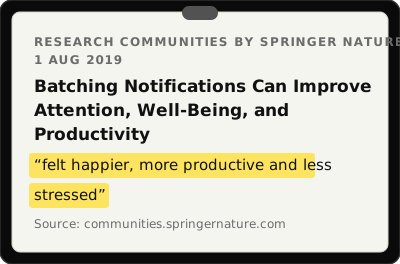
From Research Communities by Springer Nature, 1 Aug 2019.
- ·Android: Bedtime mode lets you set your sleep start and end times and days of the week, turn the screen black and white, and run Do Not Disturb. Guide: how to reduce screen time on Android.
- ·iPhone: set up Sleep in the Health app with your bedtime and wake up times, and turn on Sleep Focus, which will simplify your Lock Screen and turn on at bedtime. Guide: how to reduce screen time on iPhone.
Set the end time at or after your wake time. The notification audit helps you decide which apps deserve to make a sound at all.
4. Give the first 30 minutes a fixed job. An empty slot gets filled by the phone. A planned one does not. List below.
5. Make unlocking early cost something. Bedtime mode and Sleep Focus switch off in two taps, usually while you are lying down looking at the thing you want to open. Limits that hold take more than a thumb to undo: the phone in another room, or a block you have to get up to lift.
What should I do instead in the first 30 minutes?
Keep it boring and physical. The aim is to fill the slot the phone used to take.
- ·Drink a glass of water.
- ·Open the curtains or step outside for a minute of daylight.
- ·Wash your face, brush your teeth.
- ·Walk for ten minutes, even just down the road.
- ·Eat breakfast without a screen.
- ·Read a few pages of a newspaper or book.
Then decide your first phone time: "I pick up the phone after breakfast." On sleepy mornings a simple if then plan helps: "When the alarm rings, I get up and open the curtains." Your half awake self now has a next step that is not the phone.
How long does it take to break the habit?
Longer than a week, and it varies.
Phillippa Lally's habit research at UCL found it took 66 days on average for a new daily action to feel automatic, with a range of 18 to 254 days between people. The encouraging part: missing one opportunity did not significantly affect habit formation. The warning: very inconsistent people did not form habits at all.
How long a daily habit took to form in Lally's study
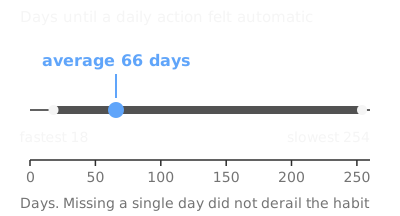
Source: UCL News, 2009 and University of Surrey, Lally interview. Days until a daily action felt automatic.
This is why the plan leans on your room rather than your resolve. A phone that sleeps in the kitchen does not need you to be strong for 66 mornings in a row. The new morning happens by default, and one bad morning does not undo it.
Where bloc fits
bloc is step 5, made physical. It is a small magnetic NFC device for your fridge, with a free app for iPhone and Android, plus bloc for Chrome for websites. In the app you pick the apps that take your mornings, say Instagram, YouTube and WhatsApp, and they block on their own, on a schedule you set (10 pm to 8 am, for example) or from a session you start in the app.
Open a blocked app at 6:45 and you see a shield screen instead, with a limited peek if you need a quick look. To unblock early, you walk to the kitchen and tap your phone on the bloc. That is the only thing the tap does. Blocking runs on its own.
The walk does two jobs. It makes the early scroll cost a trip to the kitchen, which is often enough for the urge to pass. And if you do go, you are out of bed, which is where you wanted to be anyway. Your Bloc Score drops each time you unblock early, so a week of 6:45 Instagram shows up in the number. Several phones can pair with one bloc, so a family can share it.
bloc works alongside Bedtime mode and Sleep Focus, not instead of them. Keep the phone's own settings, and let the bloc hold the line on the two or three apps you keep opening before 8. See how bloc works.
A 7 day plan to stop checking your phone in the morning
- ·Day 1: Note what time you wake, when you first unlock the phone, and which app you open first. Change nothing yet.
- ·Day 2: Buy or dig out an alarm clock. Set it for your usual time.
- ·Day 3: Set up Bedtime mode or Sleep Focus with an end time at or after your wake time. Let family calls through.
- ·Day 4: Charge the phone in the kitchen tonight, and leave the charger there.
- ·Day 5: Write your first 30 minutes on a sticky note by the bed. Pick your first phone time.
- ·Day 6: Turn off notifications for every app that is not a person. Let the rest wait for a 9 am check in.
- ·Day 7: Compare with Day 1. If the same app still pulls you back before breakfast, put it on a schedule until 8 am.
A week will not make the new morning automatic, but the structure is now in place for the next two months.
If the pull is strongest in the evening, read why you can't stop scrolling.
bloc sits on your fridge. Your apps block on a schedule. Unblocking takes a walk. See how bloc works →
Sources
- ·Business Standard, "50% Indian users unintentionally reach out for their smartphones: BCG study", February 2024
- ·Boom Live, "84% Indians check phones within 15 minutes of waking up", February 2024
- ·CBS News Philadelphia, Deloitte Global Mobile Consumer Survey, 2016
- ·PsyPost on Hughes and Burke, "Sleeping with the frenemy", Computers in Human Behavior, 2018
- ·Hughes and Burke, "Sleeping with the frenemy", Computers in Human Behavior vol. 85, 2018 (full paper)
- ·Hjetland, Skogen, Hysing, Gradisar and Sivertsen, Frontiers in Psychiatry, 2025
- ·UCL News, "How long does it take to form a habit?", Lally, 2009 (paper: Lally et al., European Journal of Social Psychology, 2010)
- ·University of Surrey, "Does it really take 66 days to form a habit? We asked the expert, Dr Pippa Lally"
- ·Fitz, Kushlev, Jagannathan, Lewis, Paliwal and Ariely, Computers in Human Behavior, 2019 (summary)
- ·Google Android Help, "Manage how you spend time on your Android phone with Digital Wellbeing"
- ·Apple Support, set up Sleep and Sleep Focus on iPhone
bloc is our product. We make and sell it, so read anything this article says about bloc as the maker's view. Every other claim links to its source.
Spot a mistake? Email support@letsbloc.com. We check it, fix it and update the date above.
Founder of bloc. IIT Kharagpur. Formerly a senior product analyst at BharatPe. Builds bloc full time from Bir, Himachal.
Free tools from bloc
Frequently asked questions
Why do I check my phone as soon as I wake up?
Because it is within arm's reach, it is your alarm, and the lock screen already shows previews of what arrived overnight. A BCG study of Indian smartphone users found around 84 percent check their phone within 15 minutes of waking, and around half the time people pick up the phone without being clear why. The morning pickup is rarely a decision. It is a reflex that the phone's position and notifications set up for you.
Is it bad to check your phone first thing in the morning?
A 2018 study in Computers in Human Behavior asked 49 people to keep their phone out of the bedroom for a week while 46 used it as normal. The group without the phone showed small improvements in happiness and quality of life and scored lower on a measure of smartphone addiction. Separately, a 2025 analysis of a 2022 survey of about 45,000 Norwegian students linked each extra hour of screen use after going to bed with 59 percent higher odds of insomnia symptoms, though that study cannot show cause.
How do I stop checking my phone in the morning?
Charge the phone outside the bedroom, buy a cheap alarm clock so there is no reason to keep it beside you, and use Bedtime mode (Android) or Sleep Focus (iPhone) so notifications stay quiet until your wake time. Give the first 30 minutes a fixed routine, and decide a first phone time, such as after breakfast. Then make unlocking early cost more than a thumb, for example by blocking the apps you reach for on a schedule that runs until 8 am.
How long does it take to stop checking your phone in the morning?
Research by Phillippa Lally at UCL found a new daily habit took 66 days on average to feel automatic, with a range of 18 to 254 days between people. Missing one day did not significantly affect habit formation, but very inconsistent people did not form the habit at all. Expect a couple of months, and lean on changes to your room rather than on daily resolve.
Ready to stop doomscrolling for good?
Try bloc — the device that actually keeps you off your phone
One-time purchase · Free shipping across India · 30 day replacement guarantee
Order bloc, from ₹1,699