In this article11 sections
- 01Can you stop using your phone completely?
- 02Is quitting completely better than cutting down?
- 03What happens when you stop using your phone?
- 04How do I quit my phone completely? Pick your level
- 05How to quit phone use, step by step
- 06How to avoid phone completely without losing UPI and WhatsApp?
- 07Is a dumb phone a good idea?
- 08How to block phone completely?
- 09Why do people keep reinstalling the apps?
- 10Where bloc fits
- 11Is phone addiction a real condition, and when should I get help?
To stop using your phone completely, first decide what "completely" means, because for most adults in India a life with no smartphone at all is not practical. The version that works is to quit the apps that hurt you (social media, short video, games) completely, keep calls, texts, UPI and maps, and add phone-free hours on top. Research backs this up: in one study, cutting down by an hour a day lasted better than giving the phone up for a week.
Written by the team that makes bloc, a phone blocker. We cover the free options first.
Can you stop using your phone completely?
You can, but few people can keep it up. Your phone is also your bank, your wallet, your map and your family group, so a total quit usually ends the first time you need to pay by UPI or book a cab.
Think about a normal week. You pay the chaiwala by UPI. Your bank sends an OTP. The school group on WhatsApp posts a change in timings. You book a cab home. None of these are the problem, but they all live on the same device as Instagram and YouTube Shorts.
So the real question is not "phone or no phone". It is which parts of the phone you want gone, and for how long.
Is quitting completely better than cutting down?
Not in the one randomized trial we found that compared them. Cutting down by one hour a day lasted longer than a full week without the phone.
Researchers at Ruhr University Bochum split 619 people at random into three groups. For one week, 200 put the smartphone completely aside, 226 cut their use by one hour a day, and 193 changed nothing. They checked in right after, one month later and four months later.
Cutting down outlasted quitting: minutes less phone use per day, four months later
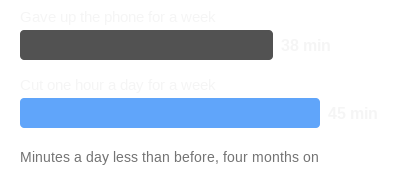
Source: Ruhr University Bochum, April 2022
Both groups felt better and improved their lifestyle. But the researchers noted that "in the group who reduced use, these effects even lasted longer and were thus more stable than in the abstinence group." The lead researcher, Julia Brailovskaia, put it simply: "It's not necessary to completely give up the smartphone to feel better."
What happens when you stop using your phone?
When people drop the internet part of the phone, they tend to feel better and focus better. In one randomized trial, 9 in 10 people improved on at least one measure.
A randomized trial of iPhone users in the US and Canada, published in PNAS Nexus in February 2025, used an app to block all mobile internet on participants' smartphones for 2 weeks. Their phones still made calls and sent texts, and they could still use the internet on a computer. The researchers found that "the intervention improved mental health, subjective well-being, and objectively measured ability to sustain attention; 91% of participants improved on at least one of these outcomes." Without mobile internet, people "spent more time socializing in person, exercising, and being in nature."
That is the honest version of "completely". Keep the phone as a phone. Drop the feeds.
How do I quit my phone completely? Pick your level
Choose one of four levels. Most people do best starting at level 1 or 2 and moving up only if they want to.
| Level | What you keep | What you drop | How hard | Who it suits |
|---|---|---|---|---|
| 1. Quit the apps that hurt | Calls, WhatsApp, UPI, banking, maps, cabs | Social media, short video, games, for good | Medium | Almost everyone, the best place to start |
| 2. Phone-free blocks of time | Everything, outside the block | The whole phone for set hours, such as evenings or Sundays | Medium | People whose worst use is at night or on weekends |
| 3. A full break for a set period | Calls and SMS, perhaps on a basic phone | All apps for a few days or a week | Hard | People who want a reset before building new habits |
| 4. Switch to a basic phone | Calls, SMS, SMS OTPs | Smartphone UPI apps, WhatsApp on most models, maps, cabs, camera | Very hard | People with few app-based duties who are sure they want out |
How to quit phone use, step by step
Measure your use, delete two or three apps, set limits that start on their own and add a phone-free block. These steps cover levels 1 and 2, which is where most people land:
- ·Measure for one day. Android: Settings, then Digital Wellbeing. iPhone: Settings, then Screen Time. Write down your total and your top three apps.
- ·Name the apps you are quitting. Usually two or three: Instagram, YouTube, a game. Be specific. "Less phone" is not a plan.
- ·Delete them. Log out first, so coming back means typing a password.
- ·Turn off notifications from every app that is not a person or a payment. Mute the WhatsApp groups that are mostly forwards.
- ·Set limits that start on their own. Use app timers, Bedtime mode or Downtime on your phone, so the decision is made before you are tired. Economists Allcott, Gentzkow and Song found that allowing people to set limits on their future screen time substantially reduces use.
- ·Pick your phone-free block. For example, 9 pm to 7 am every night, plus Sunday morning. Charge the phone outside the bedroom and use an alarm clock.
- ·Make the screen boring. Turn on grayscale and move what is left off the home screen. We looked at whether grayscale really reduces screen time.
- ·Plan what fills the gap. A walk, a book, cooking, calling someone. If nothing fills the hour, the phone will.
- ·Review after two weeks. Aim for about an hour a day less than your first measure. That is the target, not zero.
If your problem is the work day and the commute rather than the apps themselves, our 2 week plan for adults goes trigger by trigger.
How to avoid phone completely without losing UPI and WhatsApp?
Split the phone into "needed" and "not needed", and remove only the second list. You do not have to give up payments or family chats to quit the feeds.
- ·Keep: calls, SMS, your banking and UPI apps, maps, cab apps, WhatsApp for people.
- ·Remove or block: social media, short video, games, shopping apps you browse for fun, the browser if you use it to get around your own limits.
- ·For phone-free hours: tell your family and your office one way to reach you, such as a normal call. Then put the phone in another room. An urgent call will still ring.
Is a dumb phone a good idea?
It can be, for a weekend or as a second phone. As your only phone in India it costs you a lot of daily convenience, so try it before you commit.
A basic phone (a "dumb phone" or feature phone) does calls and SMS, so bank OTPs sent by SMS still arrive. What you lose depends on the model, but plan on losing smartphone UPI apps, WhatsApp, maps and cab booking. That means carrying cash or a card, asking for directions, and missing messages in groups.
A gentle way to test it: keep your SIM in a basic phone for one weekend. Leave the smartphone switched off at home. Notice what you actually missed and what you only thought you would miss. You may find you only missed two or three things, which tells you exactly which apps to keep on the smartphone.
How to block phone completely?
You cannot block the whole phone and still use it for payments, but you can block every app you do not need. Use your phone's own limits first, then add something that is harder to undo.
The free options:
- ·Digital Wellbeing (Android): app timers, Focus mode and Bedtime mode.
- ·Screen Time (iPhone): App Limits and Downtime.
- ·Delete the app and log out of it in the browser too.
- ·A basic phone for a weekend or for evenings.
- ·The phone in another room, which costs nothing.
For a guided start, try the free Digital Detox Challenge Generator.
Why do people keep reinstalling the apps?
Because quitting happens in the morning and reinstalling happens at 11 pm. When you are tired, "Ignore Limit" on iPhone, a quick trip to Settings on Android or a fresh download from the store is all it takes.
Allcott, Gentzkow and Song estimated that self-control problems cause 31 percent of social media use. That is their model's estimate, not a diagnosis, but it explains why a plan based on willpower fails on bad nights. The fix is a limit that takes more than a tap to undo. Our guide on how to block apps so you can't unblock them compares the ways to do that.
Where bloc fits
bloc is for the moment you would otherwise reinstall the app or skip your own limit. It is a small magnetic NFC device that sits on your fridge, with a free app for iPhone and Android, plus bloc for Chrome for websites.
In the app you choose the apps you want to quit. They get blocked on their own, on a schedule you set (say 9 pm to 7 am, or all of Sunday) or from a session you start in the app. Apps you leave off the list, like UPI and WhatsApp, stay open, and calls still ring.
When you open a blocked app, you see a shield screen with a limited peek. To unblock early, you walk to the fridge and tap your phone on the bloc. The tap only unblocks. Blocking runs on its own. Bloc Score shows how your blocks are going, and several phones can pair with one bloc, so a household can share it.
It is not a parental lock, and anyone can walk to the fridge. The walk adds a pause between the urge and the app, which is often enough. You pay once, there is no subscription, and it ships across India. See how bloc works.
Is phone addiction a real condition, and when should I get help?
Phone addiction is not a formal diagnosis. The WHO recognises gaming disorder in ICD-11, but not phone use in general. Problematic phone use can still be a real problem worth taking seriously.
See a doctor, psychiatrist or psychologist if phone use keeps hurting your sleep, work, relationships or mood and you cannot cut down even after trying. In India, NIMHANS in Bengaluru lists a Service for Healthy Use of Technology at its Centre for Wellbeing. The Economic Survey 2025-26 flagged digital addiction among children and young people and proposed expanding Tele-MANAS, India's mental health helpline, to support people dealing with it. It also asked parents to set screen limits and plan device-free family time.
Sources
- ·Ruhr University Bochum, "Fewer smartphones, more well-being", April 2022
- ·ScienceDaily, Ruhr University Bochum study on smartphone use and well-being, April 2022
- ·Castelo, Kushlev, Ward, Esterman and Reiner, "Blocking mobile internet on smartphones improves sustained attention, mental health, and subjective well-being", PNAS Nexus, February 2025
- ·Allcott, Gentzkow and Song, "Digital Addiction", NBER Working Paper 28936
- ·NIMHANS, Service for Healthy Use of Technology page
- ·Careers360, Economic Survey 2026 on digital addiction
- ·WHO, Gaming disorder Q&A
Ready to stop doomscrolling for good?
Try bloc, the device that actually keeps you off your phone
One-time purchase · Free shipping across India · 30 day replacement guarantee
Order bloc, from ₹1,999bloc is our product. We make and sell it, so read anything this article says about bloc as the maker's view. Every other claim links to its source.
Spot a mistake? Email support@letsbloc.com. We check it, fix it and update the date above.
Founder of bloc. IIT Kharagpur. Formerly a senior product analyst at BharatPe. Builds bloc full time from Bir, Himachal.
Free tools from bloc
Frequently asked questions
How to stop using phone completely?
Decide what "completely" means first. For most people it works best to quit the apps that hurt, such as social media, short video and games, completely, and keep calls, texts, UPI and maps. Delete those apps, block them on a schedule, and keep the phone out of the bedroom.
How to avoid phone completely?
Set a phone-free block of time, such as every evening after 9 pm or one full day a weekend. Tell family and work how to reach you, put the phone in another room or switch to a basic phone for that time, and plan what you will do instead.
How to quit phone addiction?
Aim to cut down rather than give up the phone entirely. In a Ruhr University Bochum study, people who used the phone one hour less per day were using it 45 minutes less per day four months later, which lasted better than a week of full abstinence. If you cannot cut down and it hurts your sleep, work or mood, see a doctor or psychologist.
Is it possible to live without a smartphone in India?
It is possible but hard for most adults, because banking OTPs, UPI payments, cabs, maps and WhatsApp groups for school, work and family all run on a smartphone. A basic phone still gets calls and SMS OTPs, so some people use one on weekends and keep the smartphone for errands.
What happens when you stop using your phone for a week?
In a Ruhr University Bochum study, people who put the smartphone aside for a week improved their wellbeing and lifestyle, and four months later used it 38 minutes less per day than before. People who only cut one hour a day did slightly better over time, at 45 minutes less.
Ready to stop doomscrolling for good?
Try bloc, the device that actually keeps you off your phone
One-time purchase · Free shipping across India · 30 day replacement guarantee
Order bloc, from ₹1,999