In this article11 sections
- 01The plan in 30 seconds
- 02Is it really an addiction, or just a lot of phone?
- 03Why do lectures and snatching the phone backfire?
- 04How do you talk to someone about their phone addiction without shaming them?
- 05Why does it matter for couples?
- 06How do you agree phone rules as a family?
- 07Should you change your own phone habits first?
- 08What can replace the phone?
- 09Do the phone's own settings help?
- 10Where bloc fits, if they agree
- 11When should you get professional help?
To help someone with phone addiction, talk to them calmly and privately about what you notice, without shaming. Then agree a few phone rules together that apply to everyone at home, follow them yourself first, and swap phone time for real things you do together. If the phone is damaging their sleep, work or relationships and they cannot cut down, suggest a professional, such as the SHUT clinic at NIMHANS.
That works the same whether the person is a teenager, your husband or wife, or a parent who spends the evening between WhatsApp forwards and YouTube. What rarely works is the opposite: lectures, snatching the phone, or quietly changing the WiFi password.
This page is about helping someone else. If the person you want to change is you, start with why willpower isn't enough to stop doomscrolling.
The plan in 30 seconds
- ·Notice first. What is the phone pushing out: sleep, meals, conversation, work?
- ·Talk once, calmly. Say how it affects you. No labels, no audience.
- ·Agree rules together. Two or three, for the whole house.
- ·Go first. Your phone follows the same rules.
- ·Swap, don't just take. Fill the gap with something real.
- ·Know when to get help. If it is hurting daily life and they cannot cut down.
Is it really an addiction, or just a lot of phone?
Hours alone don't tell you. The better test is what the phone is replacing. NIMHANS in Bengaluru suggests calling for help when technology has affected your daily routine and you want to change.
Before you say anything, watch for a week and ask:
- ·Is their sleep getting shorter because of late night scrolling?
- ·Do meals and conversations happen around a phone?
- ·Are studies, work or chores slipping?
- ·Do they get very irritable or anxious when the phone is away?
- ·Have they tried to cut down and kept failing?
A couple of yeses means it is worth a conversation. Many yeses, especially sleep and failed attempts, means it may be worth a professional (more on that below). Our free phone addiction quiz can be a gentle way in: you can take it together.
Why do lectures and snatching the phone backfire?
Because they turn a habit into a fight, and people defend themselves in fights. A lecture tells the person they are the problem. Taking the phone tells them you are the enemy, and the scrolling often moves under the blanket or into the bathroom.
It also helps to keep in mind why stopping is hard. Feeds are built to keep people swiping, so most of the difficulty is design, not a weak character.
And arguments about phones are already common. In a Pew Research Center survey of US teens and their parents, 38% of parents and 38% of teens said they at least sometimes argue about how much time the teen spends on the phone. More arguing is not the missing ingredient.
How do you talk to someone about their phone addiction without shaming them?
Pick a calm moment, keep it private, and talk about what you feel and miss, not what is wrong with them. One conversation, not a daily campaign.
Some ways to start:
- ·With a teenager: "I've noticed you're up late on your phone and tired in the morning. How do you feel about it?" Then listen. Many teens already know. In the same US survey, Pew found 38% of teens say they spend too much time on their smartphone, and 36% have already cut back on phone use.
- ·With a spouse: "I miss talking to you at dinner. Can we try phones off the table?" Not "You're always on that thing."
- ·With an elderly parent: "Papa, your eyes look tired after all that YouTube at night. Shall we go for a walk after dinner instead?" Respect matters more here, and so does a real alternative.
Things to avoid: doing it in front of others, comparing them to someone else, reading their messages, and using words like "addict".
Why does it matter for couples?
Being ignored for a phone has a name: phubbing, short for phone snubbing. In a Baylor University study of 453 US adults, 46.3% said their partner phubbed them and 22.6% said it caused conflict in the relationship. The researchers found that phubbing leads to conflict, which lowers relationship satisfaction.
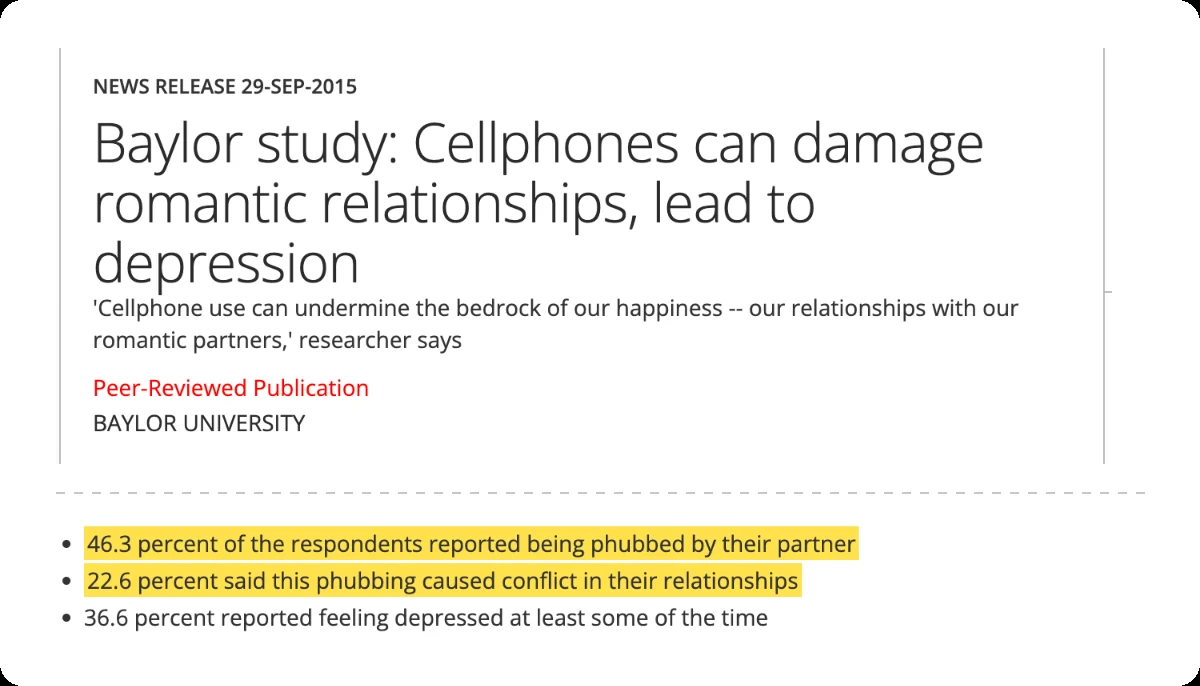
Source: EurekAlert, Baylor University, 2015
That is not a reason to accuse your partner. It is a reason to say, kindly, that you miss them.
How do you agree phone rules as a family?
Sit down together and agree two or three rules that apply to everyone, adults included. The doctors' tips in a report on the SHUT clinic are blunt: uniform rules for everyone at home are a must.
Good first rules are places and times, not hour counts:
| Rule | Why it works |
|---|---|
| No phones at the dinner table | Easy to see, easy to keep |
| Phones charge outside bedrooms | Saves sleep, the first thing late scrolling eats |
| One phone free hour in the evening | Makes room for talking, walks, games |
| Notifications off for non people apps | Fewer pulls back to the screen |
The dinner rule has evidence behind it. In a University of British Columbia study in Canada of more than 300 people eating out with friends or family, those assigned to keep phones on the table were more distracted and enjoyed the meal less than those who put them away.
India's Economic Survey 2025-26 points the same way. It encouraged parents to set screen limits, plan device free family time and learn to recognise signs of addiction, and noted that adults are also increasingly affected.
Write the rules down and put them somewhere everyone sees, like the fridge. Ask the other person which rule they want. A rule they chose is a rule they defend.
Should you change your own phone habits first?
Yes. People copy what they see, and nobody takes a rule seriously from someone who breaks it. In the same Pew survey, 46% of teens said a parent is at least sometimes distracted by their phone when they try to talk, and 47% of parents said they spend too much time on their own smartphone.
So put your phone in the basket first. Charge it outside your bedroom too. If you slip, say so out loud. That makes it a family project instead of a punishment.
What can replace the phone?
Something real, ideally something you do together. Taking the phone away leaves a gap, and boredom fills it with the phone again.
- ·Teenagers: sport, a class, cooking a meal together, time with friends in person, a part time project.
- ·Spouses: an evening walk, a shared show on the TV instead of two separate phones, cooking, a weekly outing.
- ·Elderly parents: a morning walk group, a temple or community visit, gardening, calling relatives on a call instead of forwarding videos, teaching grandchildren a recipe or game.
When NIMHANS treats tech addiction, its team says the first thing they start with is lifestyle changes such as diet, physical activity and more family time, not cutting off access.
Do the phone's own settings help?
They help with the plan, if the person sets them up willingly. Android has Digital Wellbeing with app timers and Bedtime mode, iPhone has Screen Time, and Google Family Link exists for children. Our guide on reducing screen time on Android walks through the settings.
The weak spot: every limit can be removed in a few taps from the same screen that is pulling at them, usually late at night. Limits stick better when removing them takes more than a tap.
Where bloc fits, if they agree
bloc is one way to make an agreed rule easier to keep. It is a small magnetic NFC device for the fridge, with a free app for iPhone and Android and bloc for Chrome for websites. Each person picks the apps that eat their time, and those apps block on their own on a schedule they choose, such as dinner time or 10 pm to 7 am, or during a session started in the app.
To open a blocked app early, they walk to the fridge and tap their phone on the bloc. The tap only unblocks. Several phones can pair with one bloc, so the whole family can share it, parents included.
bloc is not a parental lock. Nobody controls another person's phone with it, and anyone who walks to the fridge can unblock. It works because it is shared and agreed: the rule lives on the fridge, not in your voice, and the walk gives the urge a few seconds to pass. See how bloc works.
When should you get professional help?
When the phone is clearly hurting sleep, studies, work or relationships, when they get very distressed without it, or when repeated attempts to cut down have failed. A family doctor or mental health professional is a good first stop, and for a teenager a paediatrician can help too.
In India, NIMHANS in Bengaluru runs the SHUT clinic (Service for Healthy Use of Technology), which sees children, adults and elderly clients for gaming, social media, continuous scrolling and binge watching. In November 2022 it launched a digital detox helpline; check NIMHANS for current timings. Families are part of the treatment: parents are also counselled, and an average case can take a minimum of three months.

Source: South First, November 2022
If you ever see signs of serious distress, such as talk of self harm, get professional help straight away.
Sources
- ·Pew Research Center, "How Teens and Parents Approach Screen Time", March 2024
- ·Baylor University via EurekAlert, Roberts and David, partner phubbing study, Computers in Human Behavior, 2015
- ·ScienceDaily, Dwyer, Kushlev and Dunn, "Smartphone use undermines enjoyment of face to face social interactions", 2018
- ·Careers360, Economic Survey 2026 on digital addiction, January 2026
- ·South First, "NIMHANS launches a helpline to help you with digital detox", November 2022
- ·The News Minute, NIMHANS SHUT clinic, 2019
bloc is our product. We make and sell it, so read anything this article says about bloc as the maker's view. Every other claim links to its source.
Spot a mistake? Email support@letsbloc.com. We check it, fix it and update the date above.
Founder of bloc. IIT Kharagpur. Formerly a senior product analyst at BharatPe. Builds bloc full time from Bir, Himachal.
Free tools from bloc
Frequently asked questions
How do I help someone with phone addiction?
Start with one calm, private talk about what you notice and how it affects you, not about what is wrong with them. Agree a few rules together, such as no phones at meals or in the bedroom, and follow them yourself first. Replace phone time with real things you do together. If the phone is hurting their sleep, work or relationships and they cannot cut down, suggest a professional, such as the SHUT clinic at NIMHANS in Bengaluru.
How do I deal with someone addicted to their phone?
Treat it as a shared household problem, not a character flaw. Shaming and snatching the phone tend to make people defensive and secretive. Uniform rules for everyone at home work better than rules for one person, and phone free zones such as the dinner table and the bedroom are a simple place to start.
How do I help my spouse with phone addiction?
Say how it feels from your side ("I miss talking to you at dinner") rather than accusing. Research on partner phubbing, being ignored for a phone, links it to more conflict and lower relationship satisfaction, so the conversation is worth having. Suggest one shared rule, such as phones off the bed, and keep it yourself too.
How can I tell if someone is addicted to their phone?
Look at what the phone is pushing out: sleep, meals, work or studies, time with people, and whether they get very irritable without it or keep failing to cut down. NIMHANS describes the point to seek help as when technology has affected your daily routine. Hours alone do not decide it.
Can bloc stop someone from using their phone?
No. bloc is not a parental lock and nobody controls another person's phone with it. It works when the person agrees: the apps they choose block on their own on a schedule they set, and to open them early they walk to the fridge and tap their phone on the bloc, where the family can see.
Ready to stop doomscrolling for good?
Try bloc — the device that actually keeps you off your phone
One-time purchase · Free shipping across India · 30 day replacement guarantee
Order bloc, from ₹1,699