In this article9 sections
- 01How common is ADHD in India?
- 02Why are people with ADHD addicted to their phones?
- 03Is phone addiction a symptom of ADHD?
- 04Does phone use make ADHD worse?
- 05How do I stop phone addiction with ADHD?
- 06Which free settings help an ADHD brain?
- 07How can parents help a child with ADHD use the phone less?
- 08When should you see a doctor?
- 09Where does bloc fit?
To stop phone addiction with ADHD, stop relying on willpower in the moment, because ADHD makes exactly that harder. Instead, set up structure in advance: limits on your worst apps that start on a schedule, fewer notifications, the phone in another room while you work and outside the bedroom at night, and a short pause before the apps that pull you in. Change one thing at a time, and if you think you have ADHD, get it assessed by a professional.
Written by the team that makes bloc, a phone blocker. We cover the free options first.
This page is for adults in India who have ADHD or think they might, and for parents of children and teenagers with ADHD. It is not medical advice. Phone blockers, ours included, do not treat ADHD.
How common is ADHD in India?
About 6 in 100 children, based on the best pooled estimate. A 2022 meta-analysis of 19 Indian studies found a pooled ADHD prevalence of 63.2 per 1000 children.
ADHD in Indian children: cases per 1000 children, by type of study
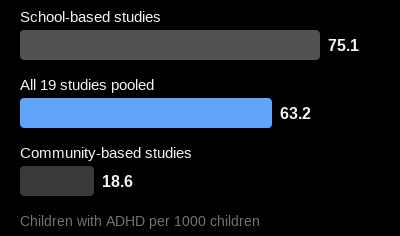
Source: Chauhan et al., Indian Journal of Pediatrics, 2022
The numbers varied a lot between studies, so treat them as a rough guide. ADHD is a diagnosis made by a psychiatrist, psychologist or doctor, not by a quiz or an article.
Why are people with ADHD addicted to their phones?
Because a phone is built from the things an ADHD brain finds hardest to ignore: new content, fast rewards and rewards you cannot predict. Impulsivity then makes it harder to stop once you start.
Dr. Todd Love, quoted by the ADHD organisation CHADD, put it this way: "The ADHD brain is predisposed to be drawn to the novel and shiny." A feed is novel and shiny without end.
ADDitude magazine adds that "screens deliver dopamine instantly", and that feeds work on unpredictable rewards, like a slot machine. You never know if the next swipe will be the good one, so you keep swiping. Their summary is short: "It's the dopamine; not the device."
Is phone addiction a symptom of ADHD?
No. It is not one of the symptoms used to diagnose ADHD. But the two often show up together, and ADHD may make problem phone use more likely.
In a study of 4,512 middle and high school students in South Korea, 338 (7.5%) were in the smartphone addiction group. The researchers found that "the odds ratio of ADHD group compared to the non-ADHD group for smartphone addiction was 6.43, the highest among all variables." They concluded that "ADHD may be a significant risk factor for developing smartphone addiction."
That study looked at one point in time, so it shows a link, not which came first. Still, if you have ADHD and struggle with your phone, you are not unusual, and it is not a character flaw.
Does phone use make ADHD worse?
Studies show a link between some screen time and ADHD symptoms, not proof that phones cause or worsen ADHD. There is no evidence that phones cause ADHD. Social media is the type of screen time that stands out.
A Montreal study followed 3,779 adolescents from 31 Greater Montreal schools every year for five years. It found that "social media was found to be the type of screen time most robustly associated with symptoms of ADHD in adolescence." Computer use was not linked. And "impulsivity seemed to be the strongest mediator between screen time and ADHD symptoms."
ADHD symptoms in that study were measured by questionnaire, not by diagnosis, and the study was observational. The practical takeaway is modest: if you cut one kind of screen time, cut social media first.
How do I stop phone addiction with ADHD?
Build the decision into your setup ahead of time, so you do not have to make it while the urge is strong. Here are seven steps, easiest first:
- ·Measure one normal day. Android: Settings, then Digital Wellbeing. iPhone: Settings, then Screen Time. Write down your daily total and your top three apps. Do not judge it yet.
- ·Cut notifications to people. Turn off every notification that is not a person talking to you. The free Notification Audit helps you sort which ones stay.
- ·Put distance between you and the phone. In a University of Texas study of nearly 800 smartphone users, people with phones in another room significantly outperformed those with their phones on the desk on tests of cognitive capacity. For focus work, put it in a bag or another room.
- ·Take the phone out of the bedroom. CHADD suggests no phones at least one hour before bed. Charge it in the hall and use a cheap alarm clock.
- ·Pre-decide limits on a schedule. Set your worst apps to switch off during work hours and late at night, so the limit starts by itself. The Focus Planner helps you plan those blocks.
- ·Add a pause before the apps that hook you. CHADD quotes Dr. Lara Honos-Webb on telling yourself you can check later and waiting 15 minutes. A pause app or a physical step does the same without needing you to choose it.
- ·Cut down, do not quit. In a Ruhr University Bochum study of 619 people, those who used the phone one hour less per day were using it 45 minutes less per day four months later, which lasted better than a week of full abstinence. All or nothing plans tend to break on the first bad day.
Why does structure work better than willpower?
Because the decision is made once, when you are calm, instead of fifty times a day when you are bored or stressed. Two studies support the idea that changing the setup changes behaviour.
In a month-long trial in PNAS Nexus, people had mobile internet blocked on their phones for two weeks, with calls and texts still working. "91% of participants improved on at least one of these outcomes": mental health, well-being or sustained attention.
A short pause helps too. A CHI 2024 study of 1,039 users of one sec, an app that adds a pause before a chosen app opens, found users dismissed 33.0% of their attempts to open those apps. The authors wrote that "the short design frictions introduced by one sec effectively reduce how often users attempt to open target apps." That was an observational study, but it fits the idea: a small pause gives the urge time to pass.
Which free settings help an ADHD brain?
Start with what is already on your phone. These all cost nothing, and you should try them before buying anything. The catch with ADHD is that most of them can be undone in a tap or two.
| Free option | What it does | Why it often fails with ADHD | What helps |
|---|---|---|---|
| Digital Wellbeing app timers (Android) | Pauses an app after a daily limit | A few taps to change or remove the timer | Set it, then hide the setting off your home screen |
| Screen Time App Limits and Downtime (iPhone) | Limits apps or blocks them at set times | "Ignore Limit" is one tap away | Have someone else set the Screen Time passcode and turn on Block at End of Limit |
| Focus mode, Bedtime mode, iPhone Focus | Pauses or silences chosen apps on a schedule (iPhone Focus can also start by place) | Easy to switch off when bored | Schedule it so it starts without a decision |
| Turning off notifications | Fewer pings pulling you back | Apps ask to turn them back on | Review once a month with the Notification Audit |
| Grayscale | Makes the screen less colourful | Quick to switch back to colour | Pair it with a schedule, not on its own |
| one sec (free for one app) | Adds a pause before a chosen app opens | You can still wait it out | Use it on your single worst app |
| Deleting apps | Removes the app completely | Reinstalling takes a minute | Delete the apps you do not need, as CHADD suggests |
| Phone in another room | Distance between you and the urge | You have to put it there each time | Make it a fixed spot, like the hall shelf |
The pattern is clear. A tool helps when the limit is set in advance and takes more than one tap to undo.
How can parents help a child with ADHD use the phone less?
Use rules about place and time, not your child's willpower. Set them up together, follow them yourself, and keep them simple enough to repeat every day.
ADDitude suggests a few practical rules for families:
- ·One central spot. Screens go in a central location after a certain hour, such as the living room shelf.
- ·Charge outside bedrooms. Devices charge outside bedrooms every night, with no exceptions.
- ·Earn access. Homework first, then games.
- ·A pact with other families. Agree with the parents of your child's friends to delay access together, so your child is not the only one.
CHADD adds a simple habit you can teach and use yourself: STOP, which stands for stop, think, observe, plan, as a pause before checking the phone.
If your child struggles a lot at school, at home or with friends, talk to a paediatrician or a child psychiatrist or psychologist. That matters more than any app.
When should you see a doctor?
See a psychiatrist, psychologist or doctor if you think you or your child has ADHD, or if phone use keeps hurting sleep, work, studies, relationships or mood and you cannot cut down despite trying. Only a professional can diagnose ADHD, and treatment is their job, not an app's.
In India, NIMHANS in Bengaluru runs a Service for Healthy Use of Technology (the SHUT clinic). The Economic Survey 2026 also proposed expanding Tele-MANAS, India's mental health helpline, in its discussion of digital addiction. Your family doctor is a good first call too.
Where does bloc fit?
bloc is for when your own limits keep getting dismissed with one tap. It is a small magnetic NFC device that sits on your fridge, with a free app for iPhone and Android, plus bloc for Chrome for websites.
In the app you choose the apps that pull you in. They get blocked on their own, on a schedule you set once (say work hours, or 10 pm to 7 am) or from a session you start in the app. That is the pre-decided structure from the steps above, without needing willpower in the moment.
When you open a blocked app, you see a shield screen with a limited peek. To unblock early, you walk to the fridge and tap your phone on the bloc. The tap only unblocks. Blocking runs on its own. The walk is a built-in pause, a similar idea to the pause in one sec, though bloc itself was not part of that study. Bloc Score shows how your blocks are going, and several phones can pair with one bloc, so a household can share it.
It is not a parental lock, and anyone can walk to the fridge. It does not treat ADHD. Keep your phone's own settings, and see a professional if you need one. See how bloc works. For more ADHD tools, read our guide to the best productivity tools for ADHD, and for a general plan, see how to stop phone addiction for adults.
Sources
- ·Chauhan, Sahu, Singh et al., "Burden of Attention Deficit Hyperactivity Disorder (ADHD) in Indian Children: A Systematic Review and Meta-Analysis", Indian Journal of Pediatrics, 2022
- ·Kim et al., "The relationship between smartphone addiction and symptoms of depression, anxiety, and attention-deficit/hyperactivity in South Korean adolescents", Annals of General Psychiatry, March 2019
- ·Wallace, Boers, Ouellet, Afzali and Conrod, "Screen time, impulsivity, neuropsychological functions and their relationship to growth in adolescent attention-deficit/hyperactivity disorder symptoms", Scientific Reports, October 2023
- ·Castelo, Kushlev, Ward, Esterman and Reiner, "Blocking mobile internet on smartphones improves sustained attention, mental health, and subjective well-being", PNAS Nexus, February 2025
- ·Haliburton et al., "A Longitudinal In-the-Wild Investigation of Design Frictions to Prevent Smartphone Overuse", CHI 2024
- ·CHADD, "Strategies to Help You and Your Child Develop Healthier Social Media Habits", ADHD Weekly
- ·ADDitude, Michael McLeod, "Why Kids with ADHD Get Stuck in the Screen-Time Loop. And How to Break It.", November 2026
- ·Ruhr University Bochum, "Fewer smartphones, more well-being", April 2022
- ·University of Texas at Austin, "The Mere Presence of Your Smartphone Reduces Brain Power, Study Shows", June 2017
- ·NIMHANS, Service for Healthy Use of Technology page
- ·Careers360, Economic Survey 2026 on digital addiction, January 2026
Ready to stop doomscrolling for good?
Try bloc, the device that actually keeps you off your phone
One-time purchase · Free shipping across India · 30 day replacement guarantee
Order bloc, from ₹1,999bloc is our product. We make and sell it, so read anything this article says about bloc as the maker's view. Every other claim links to its source.
Spot a mistake? Email support@letsbloc.com. We check it, fix it and update the date above.
Founder of bloc. IIT Kharagpur. Formerly a senior product analyst at BharatPe. Builds bloc full time from Bir, Himachal.
Free tools from bloc
Frequently asked questions
How to stop phone addiction with ADHD?
Do not rely on willpower in the moment, because ADHD makes that harder. Set up structure in advance: limits on your worst apps that start on a schedule, fewer notifications, the phone in another room while you work and outside the bedroom at night, and a pause before the apps that pull you in. Change one thing at a time.
Why do people with ADHD get addicted to their phone?
Phones are full of new things and unpredictable rewards, and people with ADHD tend to be drawn to the new and the shiny. ADDitude describes it this way: screens deliver dopamine instantly. Impulsivity, which is part of ADHD, also makes it harder to stop once you start.
Is phone addiction a symptom of ADHD?
No. Phone addiction is not one of the symptoms used to diagnose ADHD, and only a professional can diagnose ADHD. But the two often show up together: in a study of 4,512 South Korean students, the ADHD group had 6.43 times the odds of smartphone addiction compared with the non ADHD group.
Does phone use make ADHD worse?
Research shows a link, not proof of cause. A Montreal study that followed 3,779 teenagers for five years found social media was the type of screen time most robustly associated with ADHD symptoms, with impulsivity as the strongest link. There is no evidence that phones cause ADHD, but cutting back on social media is a reasonable step.
How can I help my child with ADHD use the phone less?
Make rules about place and time rather than relying on your child's self-control. Keep devices in a central spot after a set hour, charge them outside bedrooms every night, put homework before games, and agree with other families to delay phones together. Follow the same rules yourself.
Do app blockers help with ADHD?
They can help as one part of the plan, because they set the limit in advance instead of asking for willpower in the moment. They do not treat ADHD. If you think you have ADHD, see a psychiatrist, psychologist or doctor for an assessment.
Ready to stop doomscrolling for good?
Try bloc, the device that actually keeps you off your phone
One-time purchase · Free shipping across India · 30 day replacement guarantee
Order bloc, from ₹1,999