In this article12 sections
- 01In 30 seconds
- 02Why does my child cry when I take the phone away?
- 03How do I take the phone away without a tantrum?
- 04My child eats only while watching the phone. What do I do?
- 05My child wakes up and asks for YouTube. What should I do?
- 06Does my own phone use matter?
- 07What can I give my child instead of the phone?
- 08How long before the crying for the phone stops?
- 09Should I use parental controls?
- 10Where bloc fits
- 11When should I worry and see a doctor?
- 12The short version
To get a young child off the phone, stop fighting the phone and start fixing the moments it shows up in: when it is taken away, at meals, first thing in the morning and when your child is bored or upset. Give each moment a clear rule and a real activity in place of the screen, and keep your own phone out of sight while you do it. Most crying for the phone is a habit children learned, so it can be unlearned with calm, boring consistency.
This guide is for parents of children roughly 2 to 10. If you want to know how many minutes a day are fine at each age, our guide to screen time for kids by age has the IAP limits. This page is about the daily life part: getting there without a fight.
In 30 seconds
- ·Agree on how long and what comes next before the screen goes on. Stop at the end of a video, not in the middle.
- ·Don't use the phone to calm a crying child or to make them eat. Both habits are common in India and both make the phone harder to take away later.
- ·No phone in sight in the morning. Phones charge outside the bedroom, yours too.
- ·Your own phone is the model. Children copy what you do with it.
- ·Replace the screen with something. Taking it away and leaving a gap is what starts the crying.
Why does my child cry when I take the phone away?
Because the phone has become the way the child calms down, and it was taken mid-video. Both parts can be changed.
A University of Michigan study in JAMA Pediatrics followed 422 children aged 3 to 5 and their parents for six months. Children who were often calmed with a phone or tablet showed more emotional dysregulation, such as quick mood swings and impulsive behaviour. The lead researcher, Dr Jenny Radesky, put it simply: "using a distractor like a mobile device doesn't teach a skill." The crying stops, but the child never learns to settle without the screen.
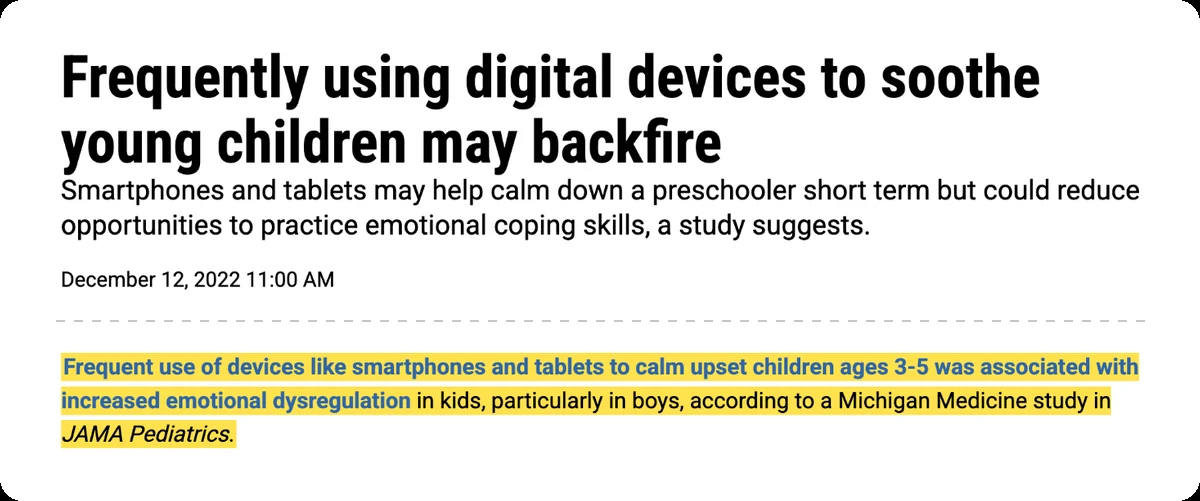
Source: Michigan Medicine, December 2022
A second JAMA Pediatrics study, of 315 preschool children, found that more tablet use at age 3.5 was linked to more anger and frustration at 4.5, and that more anger at 4.5 was linked to more tablet use at 5.5. The report described it as a possible cycle. These studies show links, not proof that screens cause tantrums, but the pattern will sound familiar to many parents.
In Indian homes the phone is very often the calming tool. An AIIMS Delhi study of 282 children aged 2 to 4 in rural Haryana, published in the Indian Journal of Medical Research, found that parents used screens to calm children in 46 percent of cases, to keep them occupied in 28 percent and to feed them in 10 percent. Nearly half of the children were over the WHO limit of one hour a day.
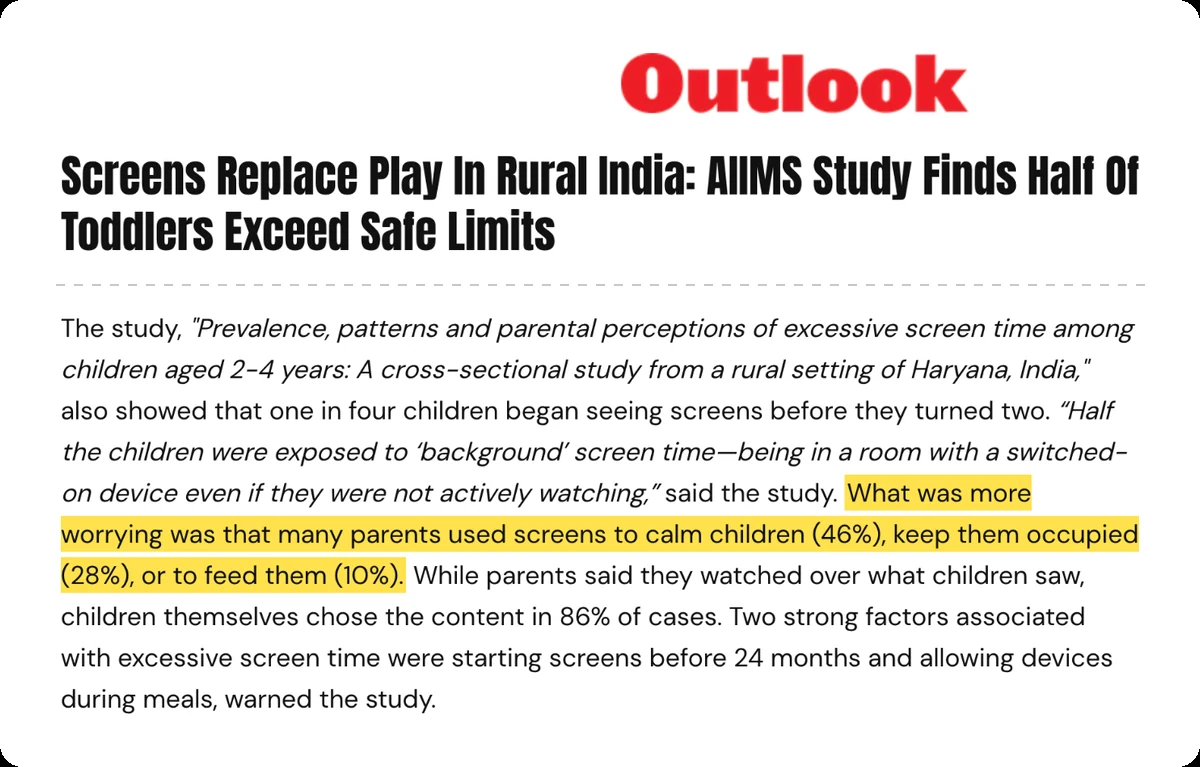
Source: Outlook India, April 2026
How do I take the phone away without a tantrum?
Make the end of screen time predictable, and give your child some control over it. These steps are drawn from Common Sense Media's advice for parents:
- ·Agree before you start. "Two videos, then we go to the park." Say it before the screen goes on, not when you want it off.
- ·Turn off autoplay. Back to back videos have no natural stopping point. Pick the videos together and let them end.
- ·Give a short warning. "Last video" or a two minute warning helps many children. A few react better with no warning at all; you will know which kind you have.
- ·Show your child how to switch it off, and let them do it. Pressing the button themselves gives them some control.
- ·Move straight into the next thing. Screen off should lead somewhere: food, a bath, a game, going out. An empty gap is where the crying starts.
- ·Praise a good handover. Notice when it goes well and say so.
If the tantrum comes anyway, stay calm and stay close. Name the feeling ("You're angry the video ended"), keep your voice low and don't argue. Radesky suggests channelling the energy into movement or a sensory activity, such as jumping, a hug or squeezing a pillow, and practising calming skills at quiet times, not only during a meltdown. The one thing not to do is hand the phone back to end the crying, because that teaches the child that crying works.
My child eats only while watching the phone. What do I do?
Wean the meal off the screen in small steps, and fill the meal with you instead. It takes patience, but it is one of the most common phone habits in Indian homes, so you are far from alone.
In a survey of 109 children aged 1 to 3 at three hospitals in Bengaluru, published in Indian Pediatrics, 73 percent of parents used screen time to help the child eat. In the AIIMS Delhi study, allowing devices during meals was one of the two factors most strongly linked to too much screen time, and the researchers advised families to "avoid phones or TV during meals and before sleep". The Indian Academy of Pediatrics (IAP) says screens should not be used to make feeding easier, and should be kept off at meals for children aged 2 to 5.
A gentle way to make the switch:
- ·Start with one meal a day, usually the one with the least rush.
- ·Sit down and eat with your child. A meal with a parent across the table is a different meal from one with a phone propped on a glass.
- ·Make the table interesting. Talk about the food, tell a story, play "what colour is this", sing.
- ·Serve smaller portions of food they already like while the habit changes. Don't fight about quantity in the same week.
- ·Keep the phone out of sight, not just face down.
- ·Expect a slow, messy first week, and keep going. Then add the next meal.
If your child is losing weight, eating very little for several days, or has a medical condition, check with your paediatrician before you change meal routines.
My child wakes up and asks for YouTube. What should I do?
Remove the cue. If no phone or tablet is in sight when your child wakes, the request gets weaker over time.
- ·Charge every phone outside the bedroom, including yours.
- ·Keep the TV remote away if the TV is the morning screen.
- ·Give the morning a fixed order: toilet, brush, milk, a little play, get ready. Same order every day.
- ·If there is screen time, give it a set time later in the day that your child knows ("after school snack"). A clear "later" is easier to accept than a "no".
The IAP also asks families to decide on a digital fasting time when no one in the family uses any device, and to use that time for each other. For many homes, the first hour of the day is a natural place to start.
Does my own phone use matter?
Yes, a lot. Children learn far more from what they see you do than from what you tell them.
A study in Pediatric Research of 172 families with children aged 5 or under found that a phone or other device interrupted parent and child time in almost every family, and that this "technoference" and children's acting out fed each other over time. The IAP asks parents to act as role models and to formulate a family media plan. Yet in the AIIMS Delhi study, only 1.3 percent of parents said they had cut their own screen use to set an example.
It is hard for a child to give up YouTube at dinner if a parent is on Instagram at the same table. If your own scrolling is the bigger problem, our guide on why you can't stop scrolling explains the pull and what helps.
What can I give my child instead of the phone?
Something they enjoy, with you nearby, especially in the first weeks. The IAP lists physical play, storytelling, music and movement for the youngest children and says screens should not be used to overcome boredom.
| Moment | Instead of the phone |
|---|---|
| While you cook | A small bowl of dough, steel utensils to bang, sorting vegetables, crayons at the kitchen table |
| After school | Park, cycle, building blocks, a friend over |
| Waiting at a clinic or restaurant | A small bag with a picture book, stickers, a notebook; "I spy" |
| Bored at home | Simple chores they can actually do: watering plants, folding towels, setting the table |
| Before bed | Bath, a story, a song, lights low |
Boredom is not an emergency. A child who is a little bored for ten minutes often finds something to do on their own, and that is a skill worth building.
How long before the crying for the phone stops?
There is no fixed number of days, and no study we know of gives one. What usually helps is doing the same thing every time: the same rule, the same calm response, the same activity after. Children test a new rule hardest at the start, so the first days are often the loudest. If the rule changes depending on how tired you are, the testing goes on longer.
Should I use parental controls?
They can help with older children. On Android, Google Family Link and on iPhone, Screen Time with Family Sharing can set app limits and a bedtime. For a child of 2 to 10, though, the habits on this page matter more than any setting, and the IAP says children up to 10 should not have their own phone or tablet at all; the device should be a parent's.
Where bloc fits
bloc is not a parental lock, and a young child won't use the bloc app. Its job here is the grown-ups' side of the habit: your own phone, and the YouTube that ends up on the family TV or a shared phone every evening.
bloc is a small magnetic NFC device for your fridge with a free app for iPhone and Android, ₹1,699, pay once. You pick the apps that eat your evenings, like Instagram or YouTube, and they get blocked on their own, on a schedule you set (say dinner to bedtime) or from a session you start in the app. Calls stay open. To open a blocked app early, you walk to the fridge and tap your phone on the bloc. The tap only unblocks, and the walk happens where the whole family can see it.
That makes it easier to keep the rules you set for your child, because they are your rules too. Several phones can pair with one bloc, so both parents can share it. See how bloc works.
When should I worry and see a doctor?
Talk to your paediatrician if your child gets extremely angry or aggressive without the phone, if eating, sleep or speech seem affected, or if the habit is not easing despite steady effort. The IAP asks paediatricians to screen children over 5 for media addiction and refer them to a mental health professional when needed. In Bengaluru, the NIMHANS SHUT clinic (Service for Healthy Use of Technology) works with technology overuse and sees children as well as adults.
The short version
Plan the end of screen time before it starts. Don't use the phone to calm or to feed. Keep phones out of sight in the morning. Put your own phone away where your child can see you do it. Fill the gap with play. Then stay boringly consistent.
Sources
- ·Michigan Medicine, "Frequently using digital devices to soothe young children may backfire", on Radesky et al., JAMA Pediatrics, December 2022
- ·HealthDay, "Greater tablet use at 3.5 years tied to more anger, frustration at 4.5 years", on Fitzpatrick et al., JAMA Pediatrics, August 2024
- ·Singh, Bairwa, Haldar and Nongkynrih, "Prevalence, patterns and parental perceptions of excessive screen time among children aged 2-4 years", Indian Journal of Medical Research, 2026
- ·Outlook India, AIIMS Delhi study of screen time in rural toddlers, April 2026
- ·Manocha and Venkatraman, "Requesting National Guidelines for Screen Time in Indian Children from IAP", Indian Pediatrics, 2021
- ·Indian Academy of Pediatrics, Guidelines on Screen Time and Digital Wellness in Infants, Children and Adolescents, Indian Pediatrics, March 2022
- ·ScienceDaily, on McDaniel and Radesky, "Technoference", Pediatric Research, June 2018
- ·Common Sense Media, how to stop screen time without a meltdown
- ·South First, NIMHANS launches a helpline for digital detox, November 2022
bloc is our product. We make and sell it, so read anything this article says about bloc as the maker's view. Every other claim links to its source.
Spot a mistake? Email support@letsbloc.com. We check it, fix it and update the date above.
Founder of bloc. IIT Kharagpur. Formerly a senior product analyst at BharatPe. Builds bloc full time from Bir, Himachal.
Free tools from bloc
Frequently asked questions
How to get child off phone without a tantrum?
Agree before the screen goes on how long it lasts and what comes next, give a short warning, turn off autoplay so videos don't run into each other, and stop at the end of a video, not in the middle. Let your child switch it off, then move straight into the next thing. If the tantrum comes anyway, stay calm, name the feeling and don't hand the phone back.
Why does my child cry for the phone?
Because a fast, bright video is hard to leave, and because many children have learned that crying gets the phone back. A University of Michigan study of 422 children aged 3 to 5 found that children who were often calmed with a phone or tablet showed more emotional dysregulation over time. The device ends the crying but does not teach the child to calm down.
How do I stop my child from eating with the phone?
Change it in small steps. Sit with your child at the table, keep the phone out of sight, give smaller portions of food they like, and talk, sing or tell a story while they eat. Expect the first few meals to be slower. The Indian Academy of Pediatrics says screens should not be used to make feeding easier, and should be kept off during meals.
How to stop child phone addiction?
For a young child, treat it as a habit to replace, not a fight to win. Fix the times the phone appears (meals, mornings, boredom, calming), offer play in its place, cut your own phone use in front of your child, and keep the rules the same every day. If your child gets very angry without the phone, or sleep and eating suffer, talk to your paediatrician.
My child wakes up and asks for YouTube. What should I do?
Make sure no phone or tablet is in sight when your child wakes up: charge phones outside the bedroom and keep the TV remote away. Give the morning a fixed order, such as toilet, brush, milk, play, and let screen time, if any, come later in the day at a set time your child knows.
Ready to stop doomscrolling for good?
Try bloc — the device that actually keeps you off your phone
One-time purchase · Free shipping across India · 30 day replacement guarantee
Order bloc, from ₹1,699